
What is a refraction eye exam?
A refraction is the test that finds the lenses you need to see clearly. It is the part of the eye exam where we ask, "Which is better, one or two?" and your answers become the prescription for your glasses.
The word comes from how light bends. When light rays bend just right as they pass through the cornea and the lens inside your eye, they land in focus on the retina, the light sensitive layer at the back. When they land short of it or past it, the result is blurry vision, and the causes are called refractive errors. Nearsightedness (myopia) blurs far away objects. Farsightedness (hyperopia) can mean trouble focusing on nearby objects. Astigmatism smears both, and presbyopia is the reading trouble that shows up after 40.
A refraction measures exactly how far off your eyes are, so a pair of glasses or contact lenses can set it right. It does not check the health of your eyes, and it does not measure how well your two eyes aim at the same spot; that is a separate binocular vision test in an eye tracking headset. Eye health is the other half of a comprehensive eye exam, and it is why the two halves can land on a bill as two lines.
Who usually pays for the refraction at a Titusville eye exam?
It depends on which card you hand us and why you came in. Here is how it usually shakes out at our two offices on S Washington Ave.
| Your coverage | The refraction | The rest of the exam |
|---|---|---|
| Vision plan (VSP, EyeMed, Davis Vision, Spectera, and others) | Usually part of the routine eye exam, often for a copay | Covered as a routine exam, once a year on most plans |
| Medical insurance | Often not covered, so you pay it | Covered when there is a medical reason, after your copay or deductible |
| Original Medicare | Not covered, so you pay it | Usually covered for a medical reason, such as diabetes or glaucoma |
| Medicare Advantage | Some plans add a routine exam that includes it | Usually covered for a medical reason |
| No plan | Part of the self-pay price | Part of the self-pay price, quoted before you book |
Who usually pays for a refraction at Aker Eye
Every plan is a little different, so treat that as a guide and call to confirm yours. We work with most vision plans and medical insurance, Medicare and AARP Medicare Complete included. Our insurance page lists them.
How do we do a refraction eye exam at our Titusville offices?
You sit in the exam chair and look through a set of lenses at an eye chart across the room. We flip between lens strengths, a little at a time, and you tell us which choice looks sharper. There are no wrong answers. If one and two look the same, say so, and we will move on.
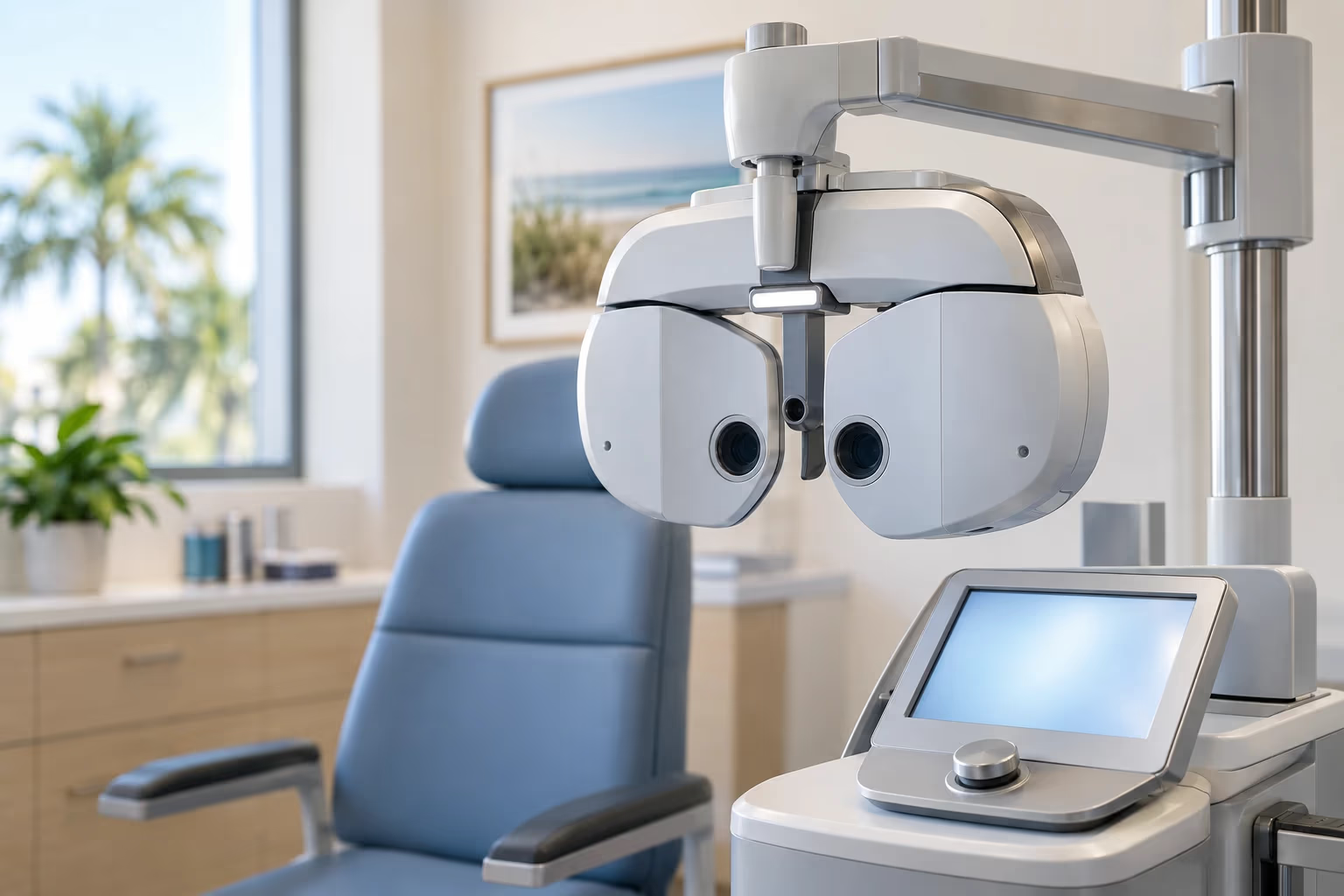
We do the refraction test on a Marco TRS-5100, a digital refracting system. It changes lenses at the touch of a button and can flip between your old prescription and your new one, so you see the difference for yourself before you order new glasses. The rest of our eye exam instruments work the same way: the results stay in your file, so next year we have something to compare.
You may remember a phoropter from an older eye exam: the big mask of dials and lenses the doctor swung in front of your face. It does the same job, and a digital refracting system is the newer version of it. Retinoscopy is a light the eye doctor shines into each eye to watch how it reflects, which gives a first estimate of the prescription without you having to answer. It helps most with young children and anyone who has trouble reading letters on a chart.
We repeat the steps up close to check your near vision, and from there the doctor determines the final numbers. If you wear contact lenses, a contact lens prescription takes its own fitting on top of the refraction, so mention contacts when you book. To make sense of the numbers afterward, how to read your eye prescription walks through each box.
Why is the refraction billed separately from the eye exam?
Because insurance treats the two halves of the visit as two different services. The medical portion checks your eye health: the pressure inside the eye, the front of the eye under the microscope, and the retina and optic nerve at the back. The refraction portion measures your glasses prescription. Health insurance pays for medical care. A glasses prescription is vision care, and many medical plans leave it out.
Our own appointment records from September 2025 through August 2026 show that about three visits in ten here are medical visits, not glasses exams. Dry eye, glaucoma checks, a diabetic eye exam, a red eye, or vision changes all go to your medical insurance. So the reason for your visit decides which plan we bill, and the refraction can end up as a line of its own.
We look for early signs of eye diseases such as glaucoma and macular degeneration at every exam, and when we find a medical condition, your medical insurance usually picks up that care. The refraction exam is the piece that stays with vision insurance or with you.
What does CPT code 92015 mean on my bill?
92015 is the billing code for a refraction. Its official description is the determination of refractive state, which is a long way of saying "we measured your glasses prescription." Every eye doctor in the country uses the same code. If you see 92015 on a statement or an explanation of benefits, that line is the refraction and nothing else.
The exam itself carries a different code, so a visit often shows two lines. When your medical plan pays the exam code and denies 92015, that does not mean anything was billed wrong. It means your plan does not cover refractions, and that part is your responsibility.
A refraction is rarely booked on its own. Only about one exam in seventy-five on our books is a refraction by itself, so for nearly everyone it comes as part of a full eye exam.

Why does Medicare not pay for a refraction?
Original Medicare does not cover routine refraction, by law. It pays for health care for your eyes, such as a diabetic eye exam or glaucoma care, but not for the test that sets a glasses prescription. That rule is the same at every eye doctor in Brevard County, not a choice we make.
About one exam in seven that we did between October 2025 and May 2026 was billed to Medicare or a Medicare Advantage plan. So this is a question we answer every week, and we would much rather answer it on the phone than at the front desk. Some Medicare Advantage plans and separate vision insurance add a routine exam that covers the refraction. Bring every card you carry, and we will bill the one that fits.
More on what Medicare covers, and what changes at the visit, is in eye exams after 65.
How can I find out what my refraction costs before my visit?
Ask us. Call (321) 269-2021 with your plan name, or text us, and we will check your benefits and tell you what the refraction will cost before you book. If you have no plan, we will quote the self-pay price for the whole visit.
- 1
Tell us every plan you have
A vision plan and medical insurance can each cover a different half of the visit.
- 2
Tell us why you are coming in
New glasses or contact lenses, a vision problem such as eye strain, or a condition we already follow all change which plan applies.
- 3
Ask for the refraction amount
We will give you the number on the phone, so checkout holds no surprises.
Many vision plans reset their benefits in January. If you have an exam left this year, now is the time to use it. Glasses exams run about a fifth above a usual month for us in December, so book your visit a few weeks ahead. If you are weighing whether a plan is worth carrying next year, is vision insurance worth it does the math.