

Is vision insurance worth it for a Titusville family or retiree?
It usually is if someone in your house buys glasses or contacts every year. It often is not if you only need a routine eye exam and keep the same frames for years. November is open enrollment season for many employer plans, and Medicare's annual enrollment runs from October 15 through December 7. So this is the month our phones fill with the same question: should I add vision coverage?
The answer depends on what your family will actually use. A vision plan pays toward the yearly exam and your glasses or contacts. A health plan pays when something is wrong with your eyes. Paying on your own works well for some people, and we quote that price before you book. Our own records from fall 2025 through summer 2026 show about two thirds of the patients we examined were on a vision plan, so most of our neighbors decided the answer was yes.
What does vision insurance cover, compared with a health plan?
Vision insurance plans and medical plans pay for different visits. Routine vision care, the exam for glasses and contacts, goes on the vision plan. Care for your eye health goes on the health plan. Coverage details vary by plan and by employer, so we read yours before you come in.
| Coverage | What it usually pays toward | What it usually leaves to you |
|---|---|---|
| A vision plan (VSP, EyeMed, Davis Vision, Spectera, and others) | A routine eye exam once a year or every two years, a frame and lens allowance, or a contact lens allowance instead, and on many plans discounts on a second pair | Lens upgrades past the allowance, non-prescription sunglasses, and any medical eye problem |
| A health plan or Original Medicare | A visit for a medical reason, such as glaucoma, dry eye, a diabetic eye exam, or a red, painful eye | The routine exam for a new prescription, and usually the eyewear itself |
| A Medicare Advantage plan | The medical visits, and on some plans a routine exam or a glasses allowance too | Whatever extras your plan leaves out, which we check before you come in |
| No plan | Nothing up front, but the price is quoted before you book | The exam and your eyewear, with HSA, FSA, and payment plans as options |
How each kind of coverage usually works for eye care at Aker Eye
Many visits with us turn out to be medical visits, not glasses visits. That is why we ask for both cards. Your vision plan covers the comprehensive eye exam and part of your eyewear. Your health plan covers care for glaucoma, dry eye, or a diabetic eye exam. If a routine exam turns up a medical problem, we tell you which plan applies before we go further.
Does vision insurance cover glasses, contacts, or both?
On most vision plans you pick glasses or contacts for the benefit period, not both. The contact lens allowance usually takes the place of the frame and lens allowance. The exam and new lenses usually renew every 12 months. Frames renew every 12 or 24 months, depending on the plan.
| Item | How most vision plans handle it | What to ask before you enroll |
|---|---|---|
| Routine eye exam | Covered once each benefit period, often with a small copay | How often the exam renews, and the copay |
| Lenses: single vision, bifocals, or progressives | Basic lenses covered with a copay, while progressives and coatings often cost extra | What you would pay for progressives or an anti-reflective coating |
| Frames | An allowance toward the frame you choose, and you pay the difference past it | The allowance, and whether it renews every 12 or 24 months |
| Contact lenses | A contact lens allowance in place of glasses | Whether the contact lens fitting is covered or is a separate charge |
| Non-prescription sunglasses | Usually not covered | Whether the plan gives a discount on a second pair |
| LASIK | A discount on some plans, rarely coverage | Which surgeons the discount works with |
| Medical eye visits | Not covered by the vision plan, since these go on your health plan | Your health plan's copay for a visit with an eye doctor |
What most vision plans pay toward, item by item
Your plan's own benefit summary has the complete details, and we read it with you if you call. Dr. Greg Aker has co-managed more than 2,000 LASIK patients, so if your plan offers a LASIK discount, ask us how it works with the surgeon you choose.
How much is it for an eye exam without insurance?
Without insurance, you pay our self-pay price for the exam, and we tell you that price by phone before you book. Call (321) 269-2021 and ask for it, along with the cost of a contact lens fitting if you want one. You get the same eye exam our plan members get, with the same doctors, and age does not change the price of a routine exam here. Costs vary with what your eyes need that day, so we name any extra testing when we quote.
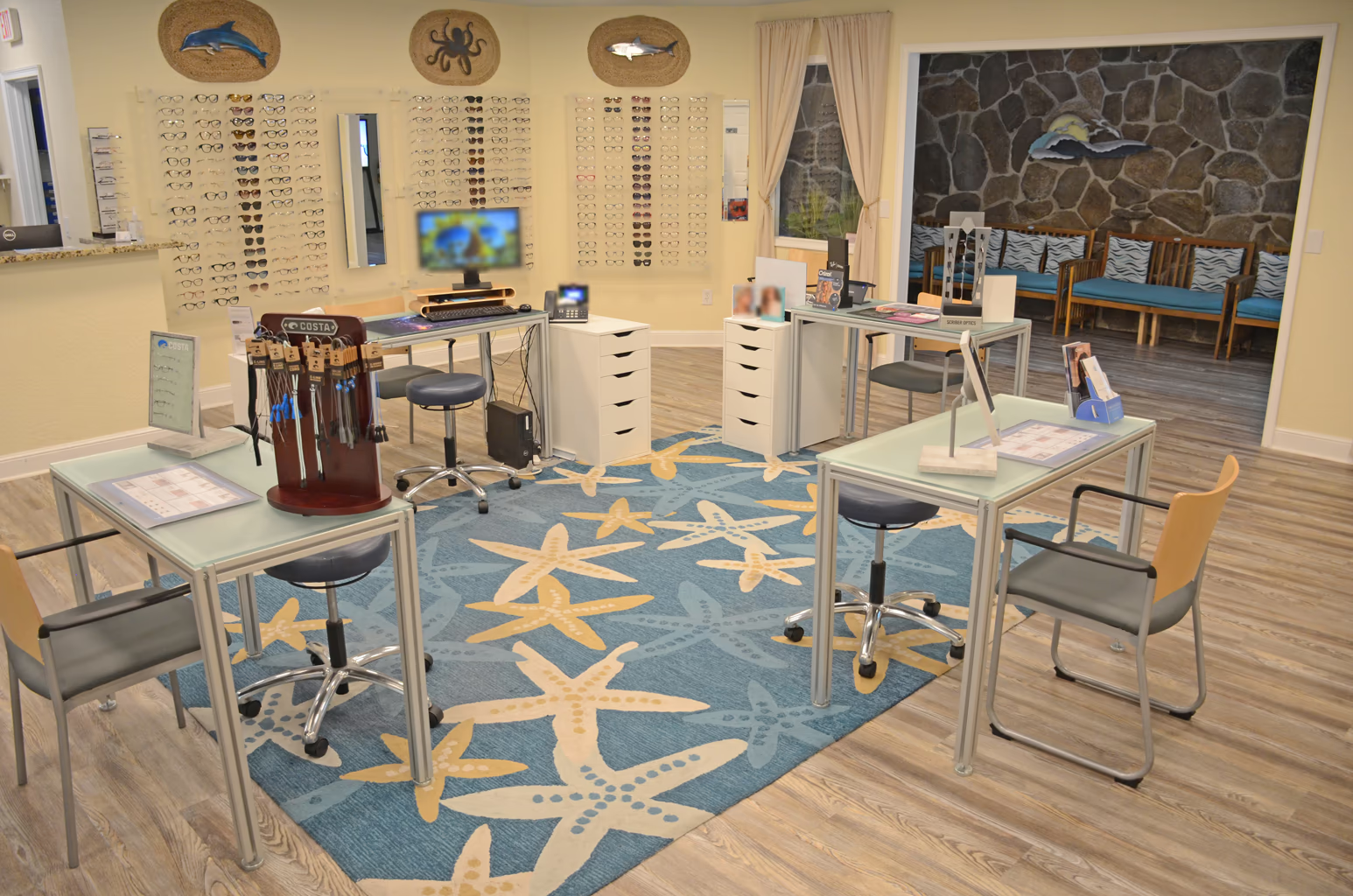
You do not have to buy glasses from us to have the exam, and you leave with a copy of your glasses prescription. About one patient in fourteen comes to us without vision coverage, so you will have plenty of company. You can shop the whole frame wall without an allowance setting the limit.
If cost is what keeps you from an exam, tell us when you call. The National Eye Institute keeps a list of programs that offer free or low-cost eye care to people who qualify, and we would be glad to help you sort out the options.
- We take cash, check, Visa, Mastercard, American Express, and Discover
- HSA and FSA cards work for exams, glasses, and contacts
- Cherry financing, CareCredit, and Afterpay spread a pair of glasses and frames over time
- Alcon rebates on contact lenses run through December 31, 2026 on our specials
Who tends to come out ahead with a vision plan?
The people who use the allowance every year. The savings come from the materials, not the exam. Many plans also give discounts on a second pair or on lens options. If nobody in your house will buy eyewear this year, the premium may cost more than the benefits return.
- Families with children who outgrow a frame or break one now and then
- Contact lens wearers, since many plans give a contact lens allowance in place of frames
- Anyone who likes a new frame every year or two, or wants prescription sunglasses
- Adults whose prescription changes often, so new lenses come with each exam
A plan helps less if your prescription is stable and you keep frames for years. It also does nothing for medical care, such as dry eye treatment or a glaucoma follow-up. If medical eye care is most of what you need, your health plan matters more than your vision plan.

Can I buy vision insurance on my own in Florida?
Yes. You can buy an individual or family vision plan on your own, without a job that offers one. Insurance companies sell vision insurance plans directly, and an insurance agent can lay the plan options side by side for you. Many are sold alone, and many come bundled with dental coverage.
First, look at the health plan you already have. If it includes vision coverage for your children or for you, a second plan may pay for the same exam twice. Then read the new policy for waiting periods, exclusions, and limitations. Some vision insurance plans for individuals make you wait before the frame or lens allowance starts. A dental and vision bundle can be a fair deal, but compare the vision part on its own.
Whatever you buy, make sure your eye doctor is on it. Here in Brevard County we also take local health plans such as Health First and Florida Health Care Plans, so call to confirm yours.
What should seniors in Brevard County know about vision insurance?
Nearly four in ten of the patients we examine are 65 or over, so we have this talk often. Medicare treats your eyes as health care, not vision care. Original Medicare usually covers a medical eye visit, such as a cataract check or a glaucoma follow-up. It usually does not cover routine eye exams for a new prescription, or the frames and lenses themselves.
That gap is why many retirees look at a Medicare Advantage plan with vision extras, or a separate vision plan. We work with Medicare, AARP Medicare Complete, Humana, and other plans on our insurance list, so call to confirm yours. If a plan is sold as dental, vision, and hearing for seniors, ask the insurance agent what the vision part pays toward frames and lenses, not only the exam. Our guide to eye exams after 65 covers what changes in the chair.
How do I check that Aker Eye is in network before I pick a plan?
Ask before enrollment closes, not after. We are a network provider for EyeMed and VSP at Downtown and Playalinda. We also work with Davis Vision, Superior Vision, Spectera, Avesis, MetLife, and others. Networks change, so call to confirm yours. Make sure we are in network on the exact plan you choose, not only the company name.
- 1
Find the plan name
It is in your enrollment packet, your benefits portal, or the summary your insurance agent sends. Note whether it is a vision plan, a health plan, or both.
- 2
Search the provider list
Look for Aker Eye in Titusville on the plan's vision provider search, or ask the plan to look up its network for you.
- 3
Call us with the plan name
We will tell you if we are in network and what the plan usually pays here for exams, frames, lenses, and contacts.
Your coverage works the same at both offices. Dr. Greg Aker and Dr. Amanda Aker see patients Downtown, and Dr. Sarah Koehnemann and Dr. Jennifer Bradley see patients at Playalinda. Which plans our neighbors use most is in our vision insurance guide.
Should I use my vision benefits before the year ends in Titusville?
If your plan resets in January, yes. The vision care benefits you paid for all year only help if you use them. Many plans reset the exam and the allowance on January 1, and an unused allowance usually does not roll over. The same goes for FSA money on many plans, so check your deadline.
January is one of our fullest months for new patients, when new patient glasses exams ran about an eighth above a usual month, so a time is easier to find now. If you have benefits left, now is a good time to book an eye exam and pick a frame. Contact lens wearers can order contacts on this year's allowance too.