
What changes at eye exams after 65?
Three things: we look harder at the back of your eyes, we dilate more often, and the bill usually goes to Medicare instead of vision insurance. The eye chart and the glasses prescription are still part of it. What grows is the eye health side, because the eye diseases that matter most after 65 give no warning on their own.
These are the eye exams we do most. Between October 2025 and September 2026, nearly four in ten of the patients we examined were 65 or over, and six in ten were 55 or over. Our exam rooms are set up for it, all four of our optometrists are used to it, and a comprehensive eye exam after 65 takes about an hour at either office.
The American Optometric Association recommends routine eye exams every year from 61 on, and we agree. A year is long enough for a cataract to thicken, a pressure to creep up, or the center of the retina to change, and short enough that we usually catch each one while there is plenty to do about it. Your eyes also tell us about the rest of your health: diabetes and high blood pressure show in the small blood vessels at the back of the eye, and we look at those at every visit.
Does Medicare cover eye exams for seniors?
Usually, when there is a medical reason for the visit, and usually not for routine eye exams whose only purpose is a glasses prescription. That one line explains most of the confusion we hear at the front desk. Medicare is health insurance, and it treats your eyes as health care rather than vision care, so a Medicare eye exam is a visit for diabetes, glaucoma, macular degeneration, a cataract, dry eye, or a new symptom. It does not cover routine eye exams for glasses or contacts.
The routine part, the refraction that sets your glasses prescription, is the part Medicare usually leaves out. Some Medicare Advantage plans add routine eye exams or an eyeglasses allowance, and some patients keep separate vision insurance for that. Coverage details vary from plan to plan, so we check what your plan covers before your visit. Call us with your plan name and we will tell you what to expect.
If you have no coverage for the routine part, ask us for the self-pay price when you book. We quote it before you come in, and there is no surprise at the desk. The plans we work with and the ways to pay are on our insurance and payment page, Medicare and Medicare Advantage included.
How much does an eye exam cost after 65?
It depends on why you are coming in and what your plan covers, and we tell you the number before you book. With Medicare or another health insurance plan and a medical reason for the visit, you typically pay your usual copay, and the eye exam cost is set by your plan. With vision insurance, routine eye exams are usually a copay as well, and the plan may pay toward eyeglasses or contact lenses afterward.
Without coverage, the self-pay price covers the exam, and the refraction for glasses may be a separate line you pay out of pocket. Retinal imaging taken as part of a routine visit is sometimes a separate charge that vision plans do not always cover. Costs vary based on those details, so ask when you call and we will quote the whole visit, with any additional costs named, before you come in. Nobody should skip eye exams over a cost they never saw coming, and nobody should have to guess what their plan covers.
What do we check at eye exams after 65, and how often?
A comprehensive eye exam, the same one anyone else gets, with a longer look at four things: the lens, the pressure, the optic nerve, and the macula at the center of the retina. Those are where cataracts, glaucoma, and macular degeneration show up, and all three become more common with age. The vision test on the chart tells us how well your eyes see; the pressure test and the look at the back of your eyes tell us about your overall eye health.
| What we check | How often | Why |
|---|---|---|
| Cataracts, the lens turning cloudy | Every year | Glare at night and dim colors are often the first signs, and surgery is one of the most fixable things in eye care |
| Glaucoma, the pressure and the optic nerve | Every year, more often once we are treating it | It takes side vision first and gives no pain or blur until some is gone |
| Macular degeneration, the center of the retina | Every year with dilation, sooner if a parent or sibling had it | Early changes show on a scan long before reading gets hard |
| Dry eye, the tear film and the oil glands | Every visit | It is common after 65 and easy to mistake for tired eyes or allergies |
| Your glasses prescription | Every year or two | Readers and progressives drift as the lens changes, and a small change makes the newspaper easy again |
What we look for after 65 and how often we look
We photograph the retina at every exam and go over the image with you on the screen. When something needs further testing, the OCT scan measures the nerve and the macula in a few seconds, and a visual field test maps your side vision. We lay each one beside last year's, and that comparison, year over year, is where most of the early catches come from. Your eye doctor reads the results with you in the room, the same day.
Will my eyes be dilated after 65?
At your first exam with us, yes. We dilate every new patient, whatever your age. After that, if you have diabetes, macular degeneration, or glaucoma, we dilate your eyes once a year, and everyone else about every three years. The drops open the pupil so we can see all the way to the edge of the retina, which the photograph alone cannot show.
Plan for it. Near vision goes blurry and bright light bothers your eyes for a few hours afterward. Bring sunglasses, and if you would rather not drive home with dilated eyes, bring a driver or book a ride. Ask when you book and we will tell you whether to expect drops that day. Dilation is the part of eye care after 65 that people dread most, and it is also the part that finds the most.
What if new glasses no longer help?
Then it may be time for a low vision evaluation, and we have a clinic for exactly that. When macular degeneration, glaucoma, or diabetes has caused vision loss that glasses cannot give back, the Low Vision Clinic at our Playalinda office works on the tasks you miss: reading the paper, the pill bottle, the oven dial, a face across the room.
Dr. Sarah Koehnemann started the clinic in 2012 and runs it. Her residency was in primary care with a special interest in low vision and ocular disease, and eight members of her own family have an inherited retinal disease, so she knows what this is like at the kitchen table as well as in the exam chair.
The evaluation runs about 90 minutes, all of it with her, and there are no dilating drops. It is billed to your health insurance, Medicare included, and a specialist copay may apply. A $50 refraction fee applies only when a new prescription would improve your useful vision. Magnifiers, telescopes, and other aids are paid for out of pocket and usually cost about what a pair of glasses does.
Which office is easier to get around for eye care after 65?
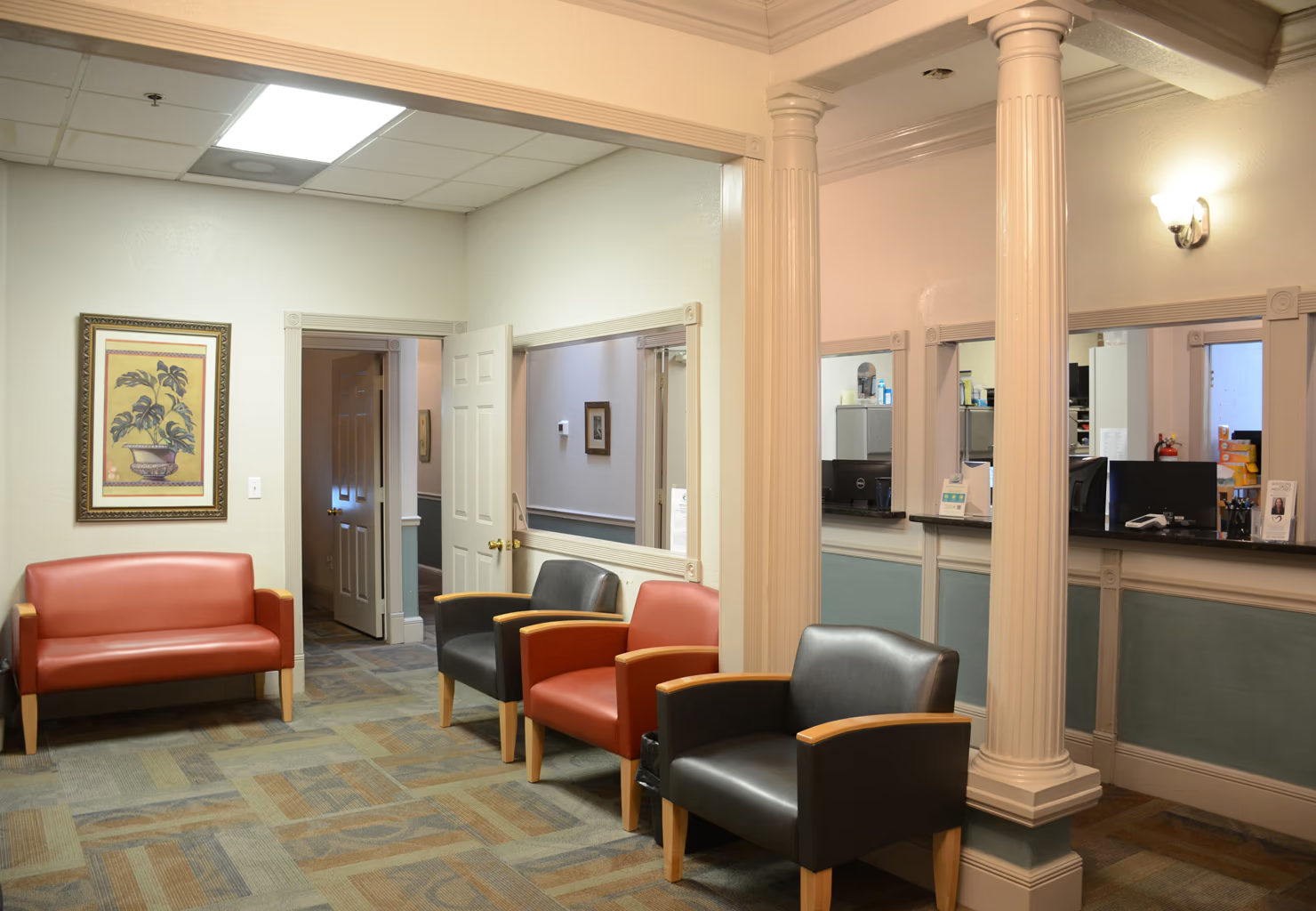
Both work, and one has no stairs at all. Our Playalinda office at 1114 S Washington Ave is a single-story building with parking at the front door and everything on one floor. Dr. Koehnemann and Dr. Bradley see patients there, and the Low Vision Clinic is there.
Our Downtown office at 338 S Washington Ave is upstairs, and the elevator is just inside the door. Dr. Greg Aker, a Southern Diplomate in Glaucoma Management and a Diplomate of the American Board of Optometry, and Dr. Amanda Aker see patients there. Our lot is behind the building, and the public parking on Julia Street is a short walk away. Directions to both offices are a call away too; phone us on your way and we will talk you in.
One more thing for anyone reading with tired eyes: every page on our site has a text-size control in the bar under the header. Two taps make the type as large as a 20-point book, and it stays that way on every page you open, the way the same eye doctor and the same office stay yours from one year to the next.
What should I bring to a Medicare eye exam?
- Your Medicare card, and the card for any Medicare Advantage or vision plan you carry
- Every pair of glasses you use, readers and sunglasses included
- Your contact lens boxes, if you wear contacts, since contact lenses need their own check
- A list of your medicines, since a few of them affect the eyes
- Anything from another eye doctor or surgeon, such as a recent report
- Sunglasses for the drive home, in case we dilate your eyes
New patients save ten minutes at the desk by filling in our forms online first. If a son or daughter is booking for you, they are welcome to come along and sit in on the exam. Book online in about a minute, or call us and a person will pick up, and we will match you with the eye doctor who fits what is going on with your eyes.