

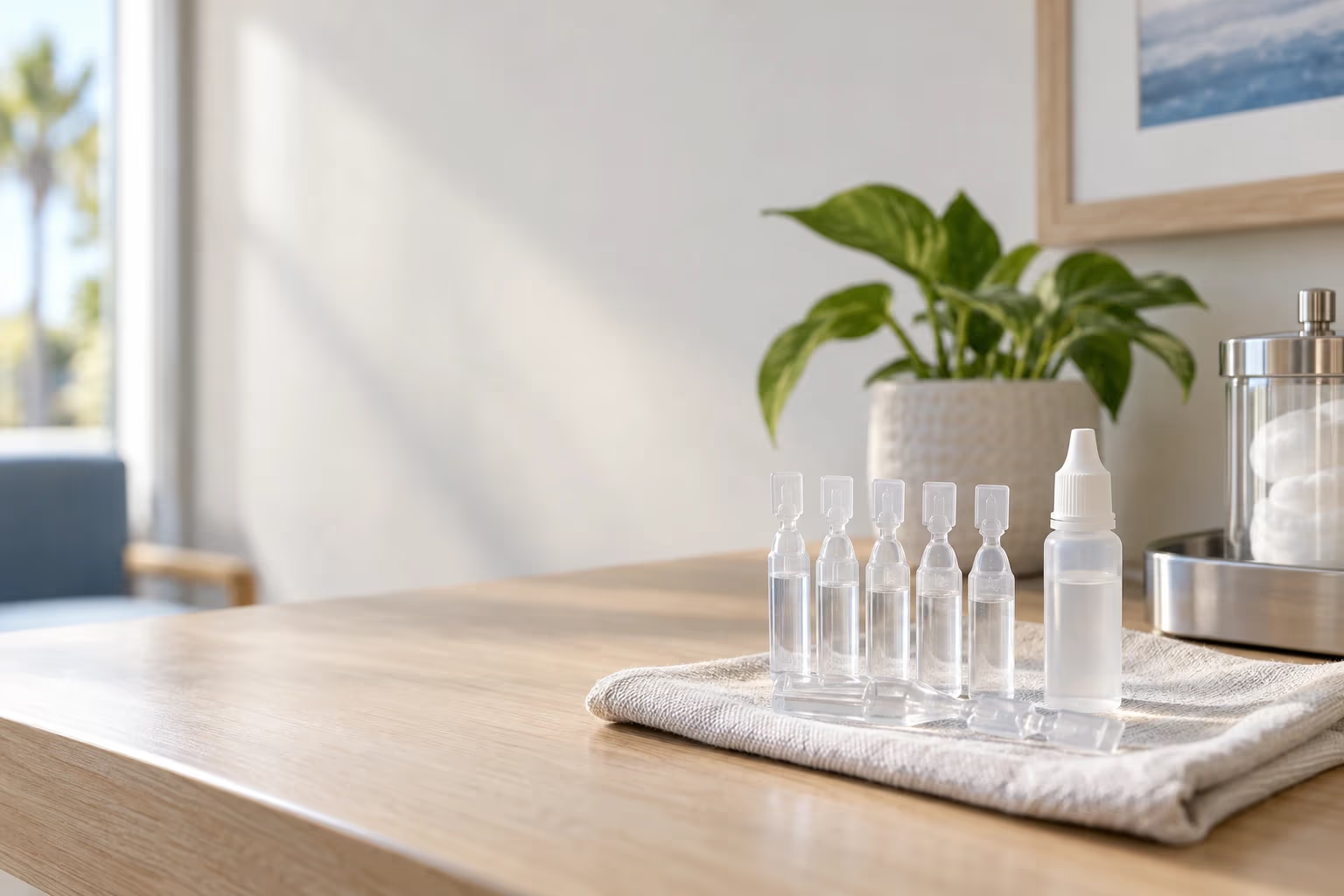
What are the best eye drops for dry eyes?
For most mild dry eye, the best eye drops for dry eyes are preservative-free artificial tears. They add moisture to your natural tears without a chemical that can sting an eye that needs drops often. The best drop for you still depends on why your eyes are dry. An eye doctor can look at your tear film and see that, and a pharmacy shelf cannot.
We evaluate and treat dry eye at both of our Titusville offices: Downtown at 338 S Washington Ave and Playalinda at 1114 S Washington Ave. A burning, gritty eye is a medical visit with us, not a glasses check. So if your eyes feel like sandpaper by the afternoon, you are in good company, and we would be glad to take a look.
What kinds of over the counter eye drops for dry eyes are there?
Most OTC eye drops for dry eyes fall into a few kinds, and all of the lubricating eye drops work by adding to your natural tears. The boxes look alike, so read the front for these words before you read the price.
| Kind | What it does | Good to know |
|---|---|---|
| Artificial tears (liquid drops) | Thin lubricating eye drops that add to your natural tears and wet the eye's surface | The usual first step for mild dryness. Quick relief that may not last long. |
| Gel drops | A thicker gel formula that stays on the eye longer, for longer lasting relief | They can temporarily blur vision for a few minutes after you put them in. |
| Ointments | The thickest kind, a protective layer over the eye | They blur vision, so most people use them at bedtime only. |
| Preservative-free vials | Artificial tears in small single-use vials, with no preservative in the formula | Gentler for sensitive eyes and frequent use. Follow the box on how long one vial is good. |
| Redness relief drops | They shrink the small blood vessels on the white of the eye | They hide redness and do nothing for dryness. Not a dry eye drop. |
| Prescription eye drops | Drops we prescribe to calm inflammation on the eye | For dry eye that over the counter drops have not settled. Sent to your pharmacy. |
The kinds of eye drops you will find on the shelf
A multi-dose bottle usually holds a preservative so it stays clean after you open it. That is fine for a drop now and then. It matters more for people who use drops all day, which is the next question.
Are preservative-free eye drops better for dry eyes?
For many people, yes, and most of all when you use drops often. Preservatives keep germs out of a bottle. With frequent use, though, they can irritate the same ocular surface you are trying to soothe. If you put drops in several times a day, or you have sensitive eyes, a preservative-free formula is the gentler pick. Most come in single-use vials, which keep each dose clean without a preservative.
Nearly four in ten of the patients we examine are 65 or over, and dry eye tends to become more common with age. Many of them use drops every day. For drops several times a day, every day, preservative-free eye drops are where we usually point people first.
Can I use redness relief drops for dry, irritated eyes?
We would rather you did not. Redness relief drops make the white of the eye look whiter by shrinking its blood vessels. They do nothing for a dry eye. With frequent use, the redness can come back when the drop wears off, and you reach for the bottle again.
If your eyes are red and dry, an artificial tear treats the dryness. If your eyes are red and painful, or your vision changed suddenly, skip the drops and call us first. That can be an eye emergency, and what counts as an eye emergency walks through the signs.
How often is too often to use eye drops for dry eyes?
Follow the box, then pay attention to how often you need the bottle. Drops relieve dry eye symptoms. They do not fix the reason your tears dry up. These signs say the drops are covering a problem rather than solving it:
- You need drops every hour to get through the day
- Drops help for an hour, then the burning comes back
- Your eyes water a lot, yet still feel dry
- Your vision blurs while you read or drive and clears when you blink
- You have used artificial tears for a couple of weeks and your eyes still burn, sting, or water
Dry eye has two main causes. Some eyes do not make enough tears, and in others the tears dry up too fast. Age, screen time, dry environments like an air-conditioned office, contact lens wear, and certain medicines can all play a part.
Drops that help for an hour and then wear off often point to the oil glands along the edge of your eyelids. When those glands clog or shrink, the oily layer of your tear film thins out and your tears dry up too fast. That is evaporative dry eye, the most common kind, and eye doctors call the gland problem meibomian gland dysfunction. More drops cannot open a clogged gland.
When should I see an eye doctor in Titusville for dry eyes?
When drops are not enough, we look for the cause. Most of our patients start with simple care at home: artificial tears, a heated eye mask, lid scrubs, and supplements. If your eyes still bother you, or you have moderate or severe dry eye symptoms, the next step is a dry eye evaluation at either office. It can include:
- A short questionnaire about your symptoms and when they bother you
- An InflammaDry test, which checks the surface of your eye for signs of inflammation
- Photos of the oil glands inside your eyelids, taken with infrared meibography
- Colored dye drops that show dry or damaged spots on the front of your eye
What we find decides the plan. It might be prescription eye drops that reduce inflammation, punctal plugs that keep more of your own tears on the eye, or OCuSOFT heat treatment in the office with gland expression. It might be a LidScrubPro lid scrub, low-level light therapy, or OptiLight IPL. Dry eye disease usually has more than one cause, so many patients use two or three treatments together.
All four of our doctors treat dry eye. Dr. Greg Aker and Dr. Amanda Aker see patients Downtown, on the second floor with an elevator. Dr. Sarah Koehnemann and Dr. Jennifer Bradley see them at Playalinda, all on one floor. The evaluation, the gland imaging, light therapy, and IPL are at both offices. Opti-Lift is the one treatment booked Downtown only, because the unit cannot move between offices.
Our own appointment book from September 2025 through August 2026 shows our light therapy visits for dry eye running at more than twice a usual month in September and climbing again in March. The weeks from December into February are the quietest for them, so winter is an easy time to start dry eye treatment with us.
Where can I buy the drops our Titusville eye doctors recommend?
At either office, or online. Both offices keep the drops we recommend most on the shelf, so you can leave your visit with the right bottle in hand. For reorders, our eye care products store on Dry Eye Rescue carries the artificial tears, gels, and lid care we recommend. The code AKEREYE takes 10 percent off, and a subscription can send the drops you use every day on a schedule.
Search the store for the drop by the name we gave you at your visit. Lost the name? Call us and we will read it from your chart. We receive a portion of each store order at no extra cost to you, and we name a drop because it fits your eyes, whichever way you buy it.
Does insurance cover eye drops and dry eye care?
OTC eye drops are not covered by vision plans or medical insurance. Many HSA and FSA plans do cover them, so check with your plan before you order. Prescription eye drops are sent to your pharmacy the usual way.
A dry eye evaluation is usually covered by medical insurance, including Medicare, because dry eye is a medical condition. Some in-office treatments, such as light therapy, are often not covered. We check your benefits before your visit, so you hear the cost before you sit down. You can check your plan first, or read which vision insurance Titusville eye doctors take.
About one appointment in eight with us is booked online, and you can book a dry eye visit that way at any hour. Or call (321) 269-2021, Monday to Friday, 8am to 5pm, and tell us it is for dry eye so we plan the right kind of visit.