
What do lights look like with astigmatism at night?
With astigmatism, a single headlight can look like a star, a smear, or a streak that runs one way. Most of the time the cause is astigmatism that is not fully corrected, and the fix is a lens that matches your eyes as they are today.
Astigmatism means the front of the eye has an uneven curvature, more like a football than a basketball. Light does not come to focus at one point, so you get blurry vision at every distance, and bright lights spread into rays. It is a refractive error, like nearsightedness. If you want the longer story of the eye's cornea and how lenses correct astigmatism, our post on contacts for astigmatism walks through it.
Why is it worse at night? In the dark your pupil opens wide to let in more light. More of the uneven surface is in play, so a small amount of astigmatism you never notice by day can turn every streetlight into a starburst after dark.
The clocks went back on November 1, so for most of us the drive home is in the dark now. On US-1 through town, which is S Washington Ave, on I-95, and out State Road 50, that means a stream of bright headlights, wet roads after a storm, and soon the holiday lights going up on every porch. If those lights look blurry or stretched to you, you are not imagining it.
Is it astigmatism, or something else making lights blurry at night?
Starry lights are a common vision condition, and astigmatism is the usual cause. It is not the only one, though. Here is how the most common causes tend to show up, and what we look at to tell them apart.
| What you see | What it often is | What we check |
|---|---|---|
| Streaks or starbursts from headlights, longer in one direction | Uncorrected astigmatism, or a prescription that has changed | Your prescription on our Marco digital refractor, old and new side by side |
| Rings or ghost images that move with your glasses | Light reflections off the lens surfaces, smudges, or scratches | Your current pair, and whether an anti-glare coating would help |
| Halos or smears that clear for a moment after you blink | Dry spots on the surface of the eye | Your tear film and the front of the eye under the slit lamp |
| Glare and starbursts, colors a little yellow, and new glasses that do not quite help | A cataract in the eye's lens | How you see with and without glare, and a dilated look at the lens |
| Sudden halos with a painful red eye, headache, or nausea | An emergency, such as an angle-closure glaucoma attack | Call us the same day at (321) 269-2021 |
Blurry lights at night: what you see, what it often is, and what we check
So if your night vision changed and the answer turns out to be more than a prescription, you are in the right place. We look at the whole eye before we talk about lenses.
Is it safe to drive at night with astigmatism?
For most people, yes, once the astigmatism is corrected. Many people with astigmatism are driving at night every day without trouble. Uncorrected astigmatism is a different story. Glare from bright headlights in your rearview mirror and from oncoming traffic takes longer to recover from, and road signs and painted lines can look soft in low light conditions.
Some people with astigmatism also notice eye strain or headaches after a long drive in the dark. If night driving has started to feel like hard work, or you squint and lean toward the windshield to read the road ahead, that is a good reason to have your vision checked. In the meantime, a few habits help:
- Clean the windshield inside and out. A film on the inside of the glass turns every light into a smear.
- Wipe your glasses before you start the car. Fingerprints and dirt scatter light just like the windshield does.
- Turn the dashboard lights down and use the night setting on your rearview mirror.
- When an oncoming car has its brights on, look toward the white line on the right edge of the road until it passes.
- Leave a little more room in rain, when wet pavement adds its own reflections.
Can an updated prescription fix astigmatism lights?
Often, yes. Astigmatism can change over the years, and a prescription that was right three years ago may be a little off now. That small miss is exactly what shows up at night, when your pupils are wide open.
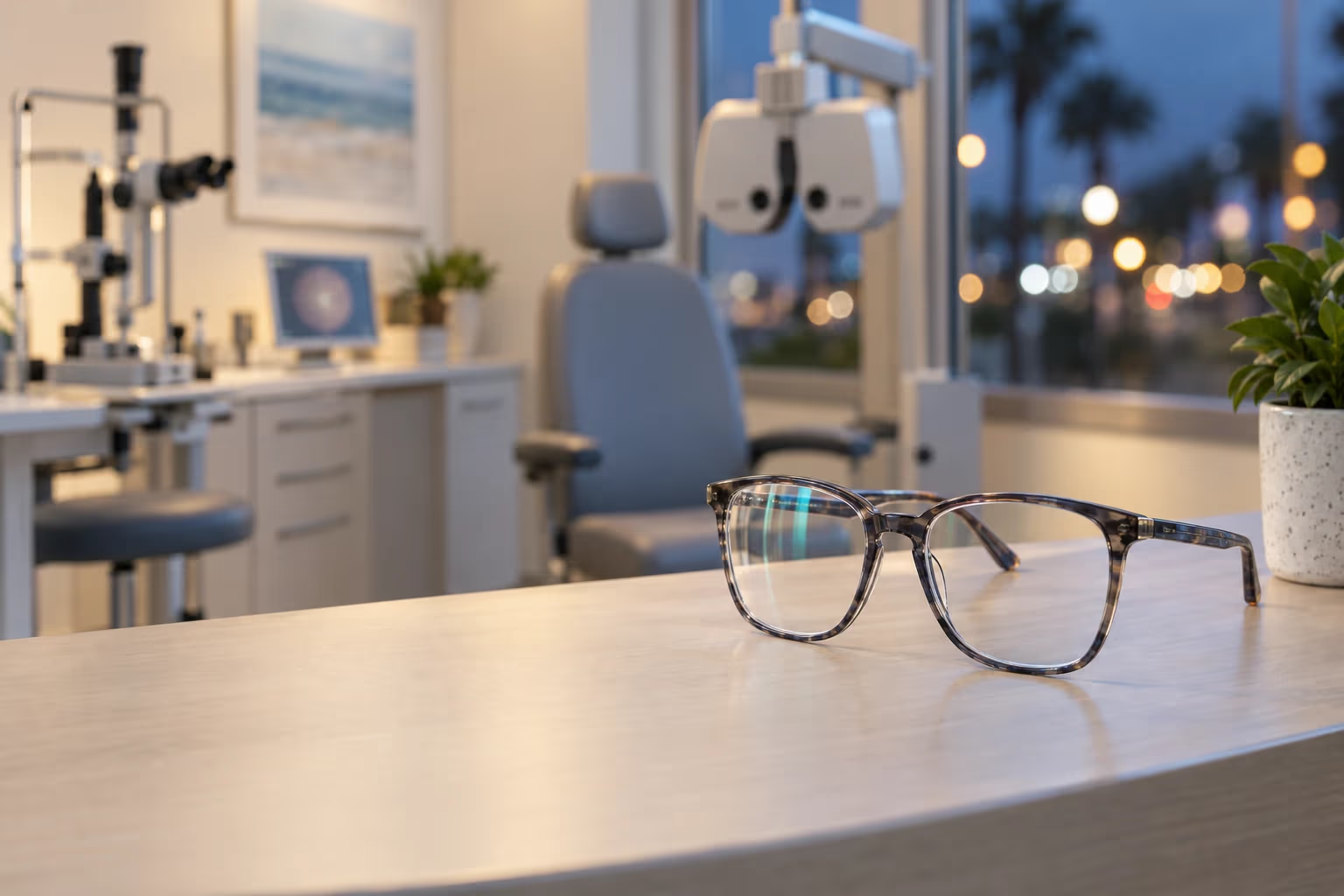
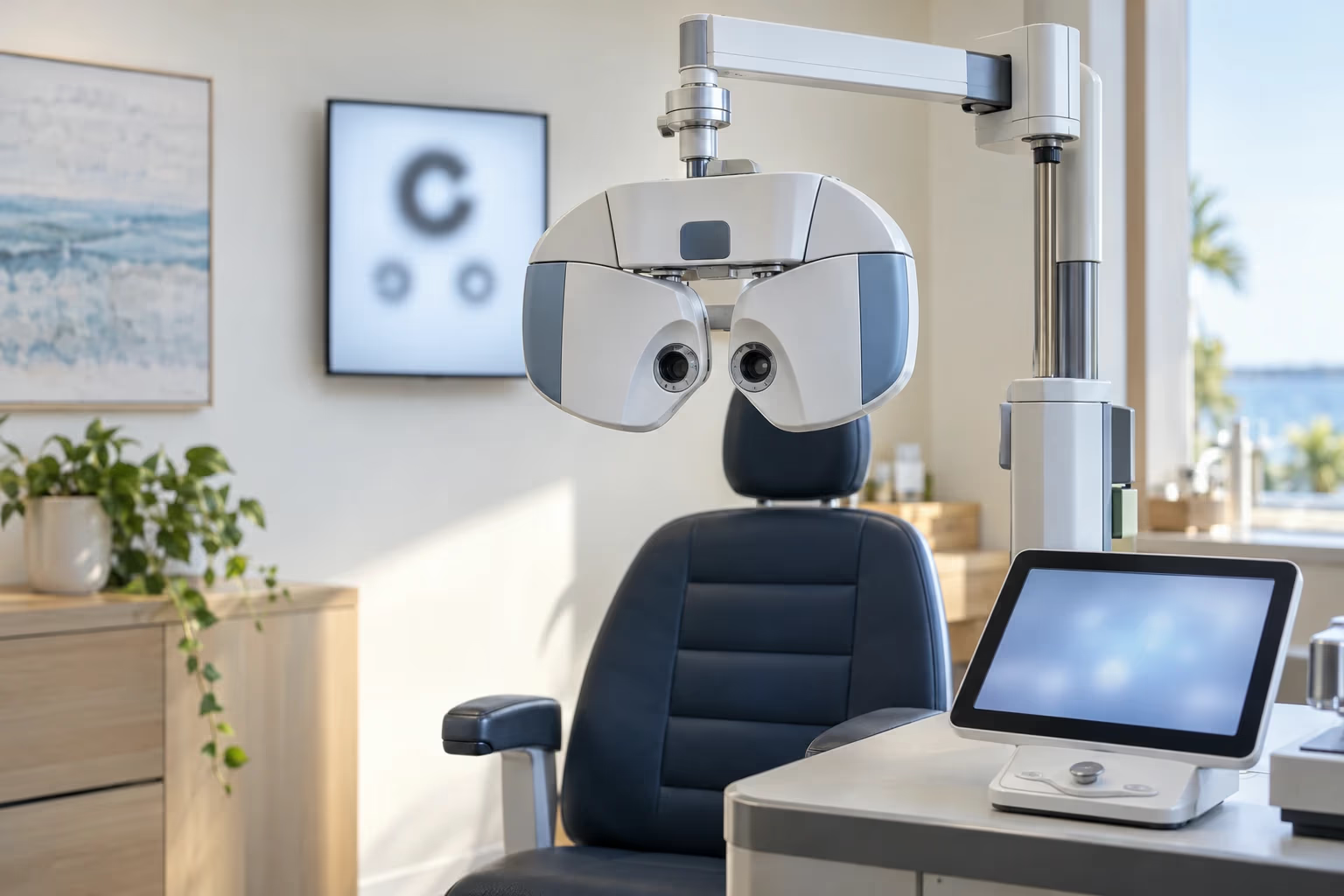
At a comprehensive eye exam we refine your prescription on the Marco digital refracting system. We can flip between your old prescription and the new one so you see the difference for yourself before you order lenses. The cylinder and axis numbers on your prescription are the astigmatism part, and how to read an eye prescription explains what each one means.
Our own appointment records from September 2025 through August 2026 show glasses exams making up nearly half of everything on our schedule, so an updated prescription is everyday work for us. The same exam checks the pressure in your eyes, your side vision, and your retina on an Optomap image, so you leave knowing more than your new numbers.
What glasses help with driving at night with astigmatism?
Start with the right prescription, then ask for an anti-glare coating. A coating such as Crizal cuts the reflections off the front and back of the lens, so headlights do not bounce around inside your glasses. Most patients who drive after dark notice it on the first night.
Polarized lenses, like our Xperio prescription sunglasses, are for daytime. They cut glare off the Indian River and hot pavement. They are too dark for driving at night.
You may see yellow tinted driving glasses sold for night driving. Any tint lets less light reach your eye, and at night you need more light, not less. We would rather fix the prescription and the reflections, which is where the blurry lights come from.
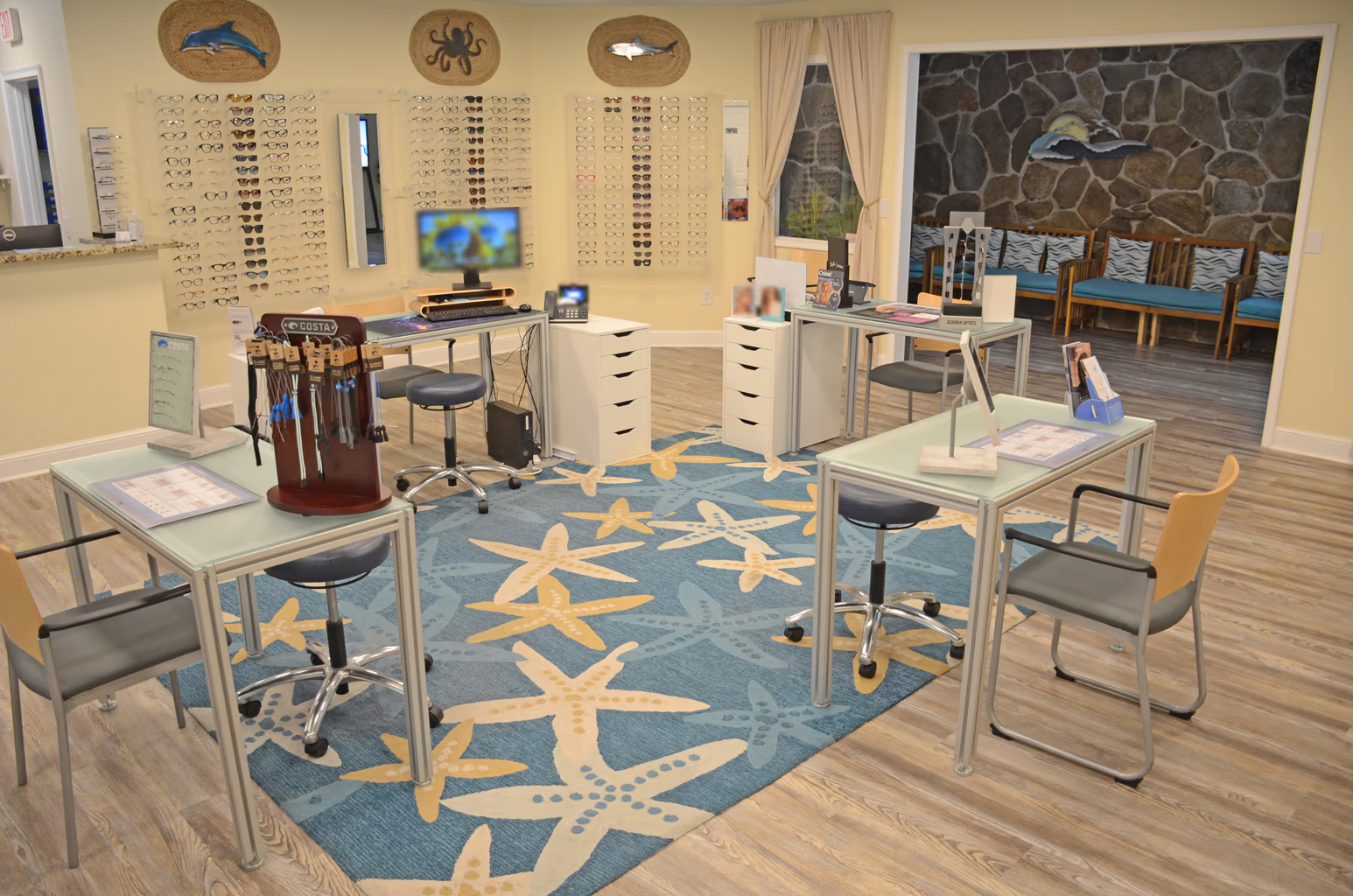
Our optical at either office can make your pair. Most glasses are ready in about two weeks, and Crizal anti-reflective lenses carry a two-year warranty with two replacements at $25 each. Browse frames and lens options on our glasses and frames page, or come try them on.
Do toric contact lenses help with night vision?
They can. A toric contact lens is built to correct astigmatism and to sit in one position on your eye. Because it moves with your eye and has no front surface a few inches away, there are no lens reflections between you and the road.
A toric lens has to stay put when you blink. If it turns, your vision blurs for a moment until it settles, and at night you notice that more. That is why we fit it on your eye before you take a box home. Our contact lens fittings cover daily torics and monthly ones, and for astigmatism a soft lens cannot correct, we fit gas perms and other specialty contact lenses.
Plenty of our patients wear contact lenses by day and glasses at night, or the other way around. Glasses or contact lenses, the goal is the same: clear images and less glare on the drive home.

When should halos around lights send you to an eye doctor in Titusville?
If the lights have slowly gotten worse over months, book an eye exam. That is the usual pattern for astigmatism, a drifting prescription, or an early cataract. Cataracts often show up first as glare and starbursts at night, long before they show on an eye chart. Six in ten of the patients we examine are 55 or over, the years when a cataract evaluation becomes part of the conversation.
If halos came on suddenly, sit in one eye, or come with pain, redness, a headache, or nausea, do not wait. That is an eye emergency. Call us at (321) 269-2021 and we will see you that day.
November is a good month to come in. Last November, exams for our returning glasses patients ran about a quarter below a usual month, so times are easier to find before the holiday rush. You can book your visit online tonight.
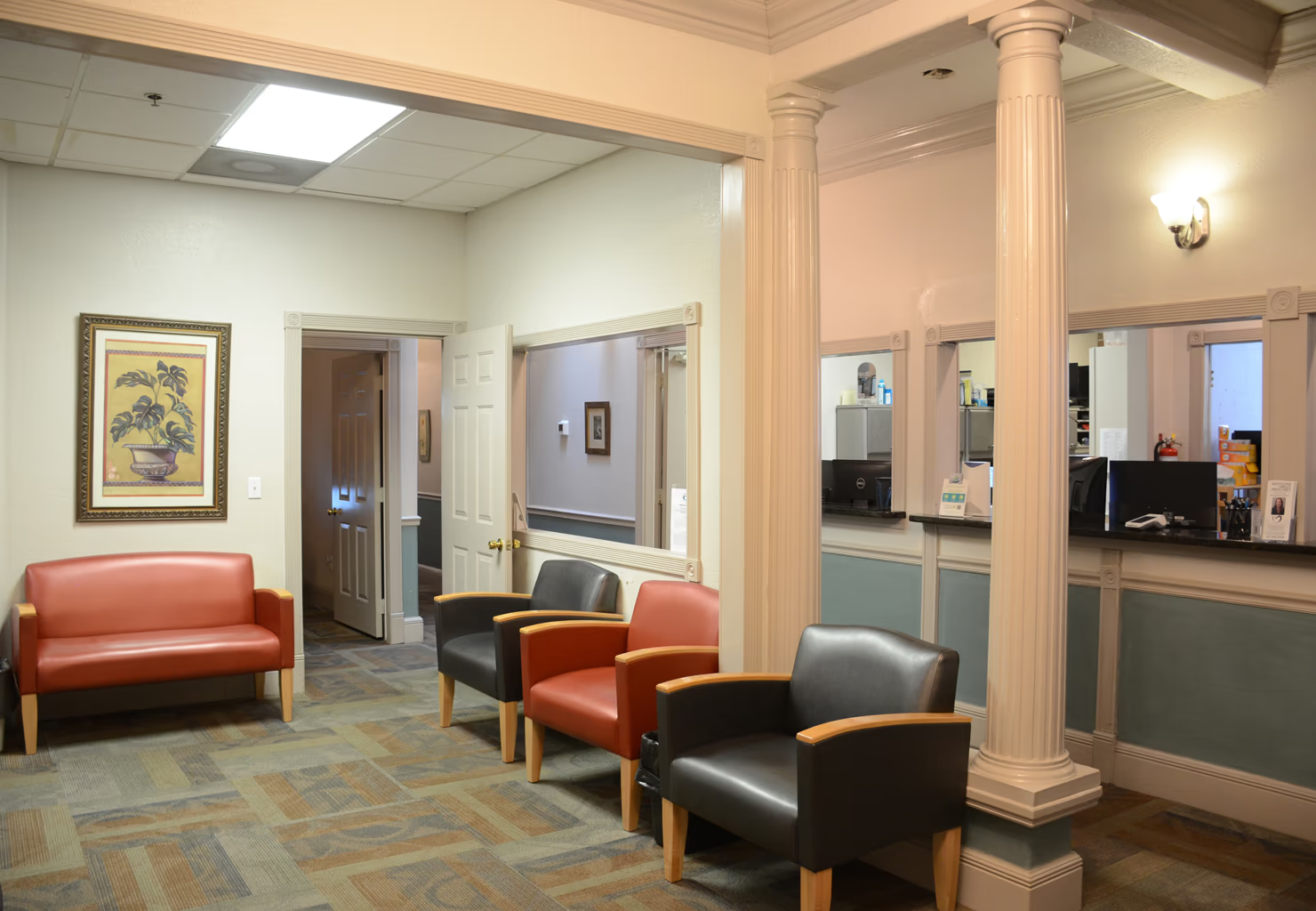
Dr. Greg Aker and Dr. Amanda Aker see patients at Downtown, 338 S Washington Ave, up the elevator on the second floor. Dr. Sarah Koehnemann and Dr. Jennifer Bradley see patients at Playalinda, 1114 S Washington Ave. Both offices sit right on US-1, so the drive is easy in daylight, too.