
How do I read my eye prescription?
Learning how to read eye prescription numbers starts with the rows. OD is your right eye, short for oculus dexter, and OS is your left eye, short for oculus sinister. Those are the Latin names optometrists still use. Some prescriptions say OU, for oculus uterque, which means both eyes. Each eye gets its own line, because the two eyes almost never need the same lens power.
Our own appointment records from September 2025 through August 2026 say about one exam in four is a new patient. So for plenty of our neighbors, the slip we hand over is the first eye prescription they have ever been asked to read.
Then read across. SPH, CYL, and Axis set the main vision correction for each eye. ADD shows up for reading help, prism shows up only now and then, and PD may or may not be written on the slip at all. Here is what each number means in plain words.
| On the slip | What it means | What to look for |
|---|---|---|
| OD, OS, OU | Right eye, left eye, both eyes | The top row is almost always your right eye |
| SPH (sphere) | The main lens power needed to correct your vision | A minus sign means nearsighted, a plus sign means farsighted |
| CYL (cylinder) | Extra power for astigmatism, often called the cyl number | Blank or a dash means no astigmatism correction is needed |
| Axis | The direction of the astigmatism correction | A number from 1 to 180; it is an angle, not a strength |
| ADD | Extra power for reading, added to the distance power | Often appears in your 40s, for progressive lenses or bifocals |
| Prism and PD | Prism lines up the image; PD is the space between your pupils | Prism is rare; we measure PD when you order with us |
The parts of an eyeglass prescription
What does SPH mean for glasses, and is near vision plus or minus?
SPH, short for sphere, is the lens power needed to bring the world into focus. It is measured in diopters, in steps of a quarter: 0.25, 0.50, 0.75, and so on. A positive number and a negative number mean very different eyes, so read the sign first.
The sign tells you the direction. A minus sign means nearsightedness, also called myopia: up close looks fine and the road signs are the trouble. A plus sign means farsightedness, or hyperopia, and near work takes more effort than it should. Both are refractive errors, which simply means the eye bends light a little short of or past its target. The higher the number, the stronger the lens.
A small number is not a grade on your eyes. Someone at minus 0.75 and someone at minus 6.00 can have equally healthy eyes. The prescription only says how much correction each eye needs. Your eye health is a separate part of the comprehensive eye exam, with the pressure check and the look at your retina. That is why regular eye exams matter even when your eyeglasses still seem fine.
What part of my prescription shows astigmatism?
CYL and Axis, together. Astigmatism means the cornea, the clear front of the eye, is shaped a little more like a football than a basketball instead of perfectly round. Light focuses unevenly, so you may notice blurred vision at every distance, eye strain, or headaches after reading. The cyl number is how much astigmatism correction the lens carries. It can be written with a plus or a minus sign, depending on the doctor who wrote it, and both forms make the same eyeglass lenses.
Axis is the direction that correction points, written in degrees from 1 to 180. A higher axis number is not worse. It is simply the orientation of the lens on your eye, the way a compass bearing tells you where to point. If CYL is blank, the Axis is blank too, and there is no astigmatism to correct.
What does ADD mean, and why did it show up after 40?
ADD is extra plus power for reading. Somewhere in the 40s the lens inside the eye stiffens, a normal change called presbyopia, and near vision gets harder no matter how good your distance eyes are. The menu moves farther away, and then your arms run out.
The ADD number is the same for both eyes on most prescriptions. It is what turns a distance prescription into progressive lenses, bifocals, or reading glasses. Progressives are multifocal lenses that put distance, computer, and reading in one lens with no line, which ends the swapping between two pairs. Some people would rather wear bifocals, and that works too.
Prism is less common. It moves the image a little so both eyes can line up on it, and it is written with a direction such as BU, BD, BI, or BO. If your prescription has prism, the measurements in the frame matter even more, so those are eyeglasses we would want to fit in person.
What is PD in glasses, and why do we measure it?
PD, or pupillary distance, is the space between the centers of your pupils, measured in millimeters. It tells the lab where to place the center of each lens so it sits in front of your eye. A lens that is not correctly centered can cause eye strain even when every other number is right.
Many prescriptions leave PD off, because it is a measurement for making glasses rather than part of the exam. When you order glasses with us, we measure your PD and where your eyes sit in the frame you picked. Progressive lenses and bifocals need that second measurement, since the reading area has to land where your eyes look down.
Ordering online from somewhere else? Most online retailers ask for your PD, so ask us for it at your visit, and say what kind of lenses you plan to buy. If the pair still does not feel right, bring it in and we will take a look at how the lenses line up.
Is my glasses prescription the same as my contact lens prescription?
No, and you cannot order contact lenses from an eyeglass prescription. Eyeglasses sit about half an inch in front of your eye, and a contact lens rests on it, so the powers are often different. A contact lens prescription also names the brand, the curve, and the size, which come from a fitting with a trial lens on your eye. Contact lens visits are a little under one in five on our schedule, and each one ends with its own prescription, separate from your glasses.
Your contact lens prescription is good for about a year in most cases, and we renew it at your yearly contact lens exam. How long a glasses prescription stays current depends on your eyes and your health, so ask us when you check out. If you want both glasses and contact lenses, tell us when you book and we will do the exam and the fitting in the same visit at either office.
What do I do with my eye prescription now?
Put it to work. About 43 frames leave our optical for every 100 comprehensive eye exams we do, so a new eyeglass prescription and new eyewear often go home together. About one frame in six we sell is a sunglass, usually a second pair made with the same prescription for the drive and the beach.
- 1
Browse frames from home
Try frames on from home with your phone camera, then call or text us to set aside the ones you like.
- 2
Come to the optical
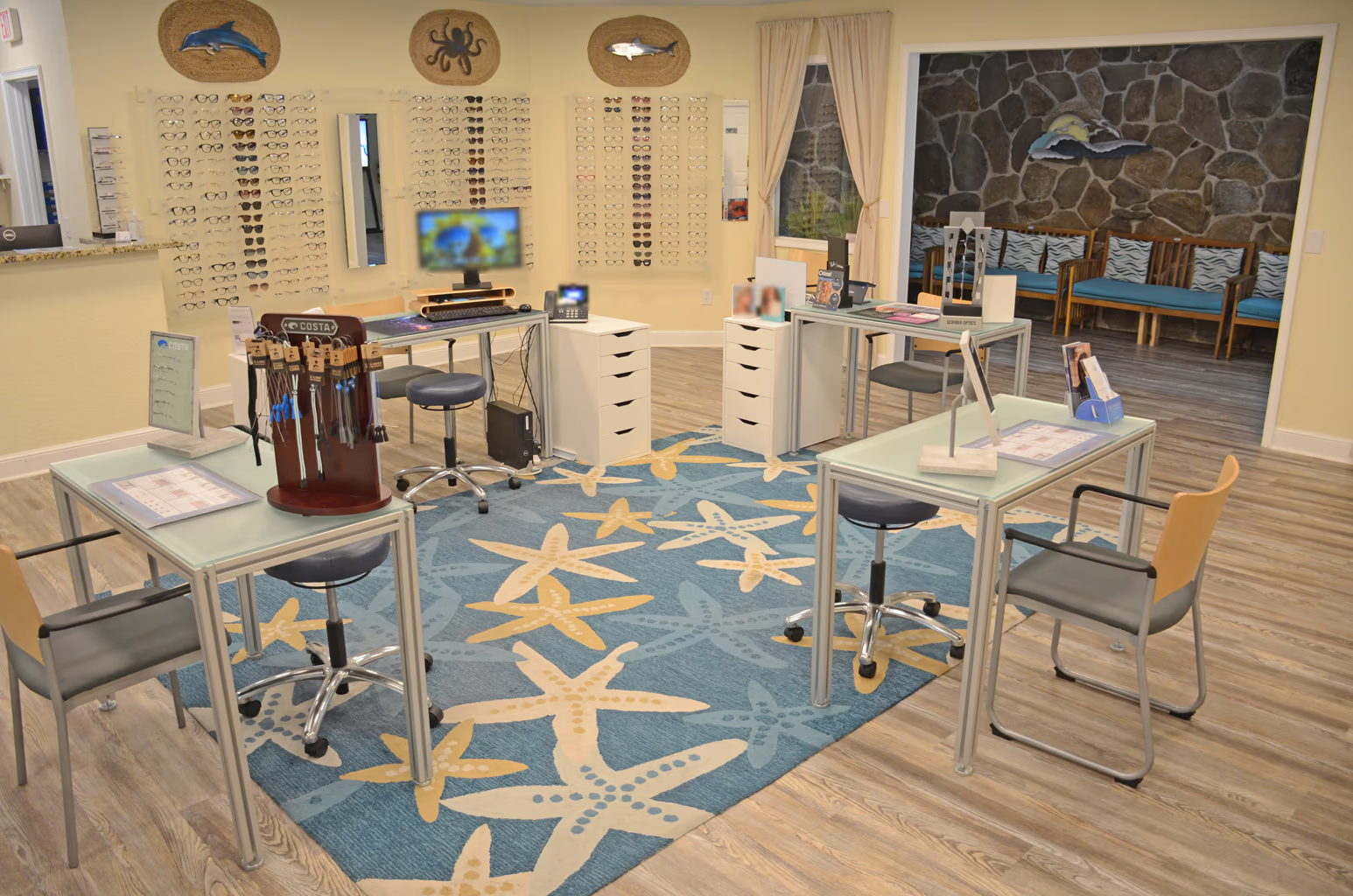
At Downtown, 338 S Washington Ave, the exam rooms are upstairs and the glasses and frames shop is on the ground floor. At Playalinda, 1114 S Washington Ave, the optical is on the same floor as the exam rooms. We fill prescriptions from other eye doctors too.
- 3
Pick lenses with us
We go over each lens option and its price before you say yes, apply your vision plan, and measure your fit. More than half of our exam patients use EyeMed or VSP, and those plans put an allowance toward your frames. Glasses usually take about two weeks, and we call you the day they arrive.
- 4
Reorder contacts online
If your contact lens prescription with us is current, reorder contact lenses any time. The store matches you to the prescription on file, so there is no box to hunt down.
Every frame we sell carries a one-time replacement warranty for a year, and lenses with Crizal or our premium scratch coating are covered twice over two years. If your eyeglass prescription is more than a year old or your vision has changed, book an eye exam first and shop for frames the same afternoon.