
What are progressive lenses, and how do they work?
Progressive lenses are multifocal lenses that hold three prescriptions in one pair of glasses: distance vision at the top, intermediate vision in the middle, and near vision at the bottom. There is no visible line between the zones, because the power changes a little at a time as your eyes move down the lens.
That middle zone is what sets progressive lenses apart. Intermediate vision is everything at arm's length: the computer screen, the dashboard, the price tag on a shelf at the store. Lined bifocal lenses skip it, so those things can look blurry through either half.
Here is how progressive lenses work in daily life. Look straight ahead and the top portion of the lens gives you distance vision for the road. Drop your eyes a little and the laptop comes clear. Drop them a little more and the near zone makes the menu sharp. Eye doctors also call them progressive addition lenses, or PALs, after the ADD power that gives the lower portion its reading strength.
That ADD number usually shows up in your 40s, when the lens inside the eye stiffens and close up focus gets harder. It is a normal change called presbyopia. If you have started holding your phone farther away, how to read your eye prescription explains where the ADD sits on the slip.
Progressive lenses vs bifocals vs reading glasses: which is better?
None of them is better for everyone. The right lens depends on how you spend your day. Here is how the three most common choices compare.
| Lens | What you see through it | The trade-off |
|---|---|---|
| Progressive lenses | Far, middle, and near in one lens, with no line | The sides of the lens are soft, and new wearers need a week or two to adjust |
| Lined bifocals | Distance on top, a wide reading area in a window at the bottom | A visible line, an image jump as your eyes cross it, and no middle zone for the computer |
| Single vision reading glasses | One power, sharp up close only | Everything past arm's length is blurry, so they come off and on all day |
Progressives, bifocals, and readers side by side
Some people wear bifocals or trifocals for thirty years and love the wide reading window. Trifocal lenses add a middle strip for intermediate distances, but with two lines instead of one. Others keep single vision glasses for distance and a pair of reading glasses in every room. All of these are fine choices, and we fit every one of them.
Progressives win for most people because one pair does the work of two or three. If you want to try them, a comprehensive eye exam gives us your current distance and reading powers to build them from.
What types of progressive lenses are there?
You will hear a few names at any optical. The types of progressive lenses differ in how wide the clear zones are and how the lens is made:
- Standard progressive lenses: one design made for most wearers. A good start if your prescription is mild and your day is mostly driving and reading.
- Premium progressive lenses: usually freeform lenses, cut by computer to your prescription and your frame. They tend to give wider intermediate and near zones and softer edges.
- Short corridor lenses: the zones packed closer together, so they fit in smaller frames that are not very deep.
- Computer progressive lenses: a wide intermediate zone and near zone for desk work, with less room for distance vision. Many people keep them as a second pair.
Varilux is one of the progressive lenses we fit. We will tell you which type suits your prescription, your frame, and your day, and what each one costs, before you choose.
Who should wear progressive lenses in Titusville?
Our appointment book from September 2025 through August 2026 shows glasses exams filling about half of our schedule. Progressives come up in many of those visits, and age is the reason. About seven in ten of the patients we examine are 45 or older, right in the years when reading starts to slip.
You are a good candidate if you already wear glasses for distance and now need help up close too. You may also be one if you keep switching between multiple pairs, or if you spend your day moving between a screen, a desk, and the room.
Progressives are a harder fit for a few people. Someone who reads for hours at a time may prefer the wider reading area of a bifocal or a pair of readers. Work that means looking up at something close, like an electrician under a ceiling, can call for a special pair. And if you dislike glasses altogether, we also fit multifocal contact lenses, which work on a similar idea.
What are the first two weeks in progressive glasses like?
Most new wearers notice two things. The floor may seem to tilt or swim a little when you turn your head, and the peripheral areas of the lens look soft. That peripheral distortion is part of every progressive design, since the clear zones sit in a channel down the middle. Your brain learns to use that channel, and many people adapt within a week or two.
These tips help most new wearers get used to progressive lenses faster:
- 1
Wear them all day
Put them on in the morning and keep them on until bedtime. Switching back to your old glasses resets the adjustment period every time.
- 2
Point your nose at it
Turn your head toward what you want to see instead of glancing sideways. The clearest vision is straight down the middle of the lens.
- 3
Lower your eyes to read
Keep your chin level and drop your eyes to the bottom of the lens. Hold the book or phone a little lower than you are used to.
- 4
Tip your chin down on stairs
Look through the top of the lens at each step, not the reading part. Use the handrail for the first few days.
- 5
Lower the computer screen
Set the monitor a bit lower so the middle of the lens lines up with it, without tilting your head back.
- 6
Practice at home first
Wear them around the house for a day before your first drive across the causeway.
Why do the measurements and the frame choice matter so much?
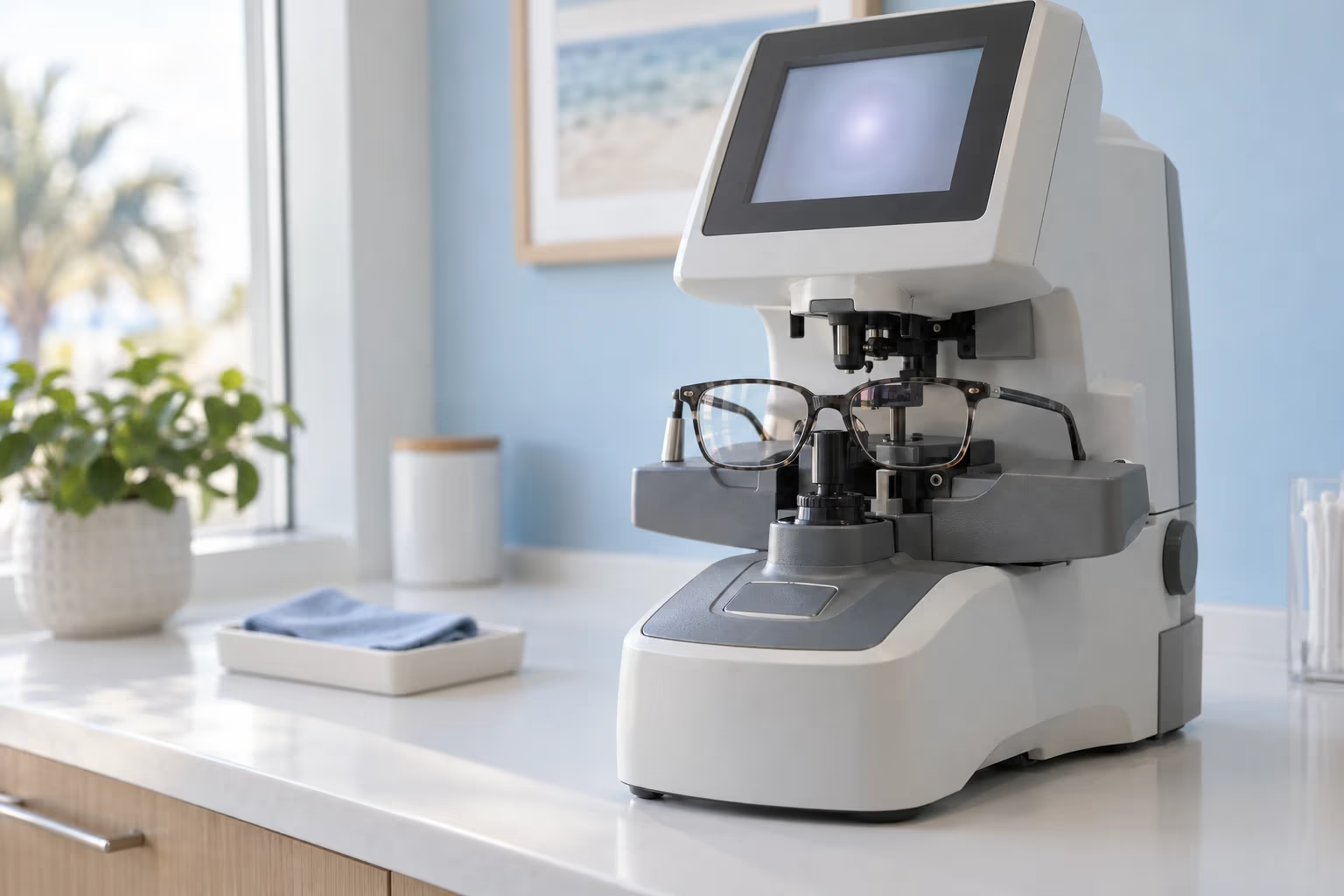
A progressive lens only works when its channel lines up with your pupils. So after you pick a frame, we measure your pupillary distance and how high your eyes sit in that exact frame, with it on your face. A miss of a millimeter or two can push the reading zone off to the side or too low. Many common problems with progressive lenses start there, not in the lens.
The frame matters too. A very shallow frame leaves little room for the near vision zone, so reading feels cramped. A frame that slides down your nose moves every zone with it. Our opticians will steer you toward frames deep enough for your prescription, and adjust the fit at pickup so it sits straight and stays put.
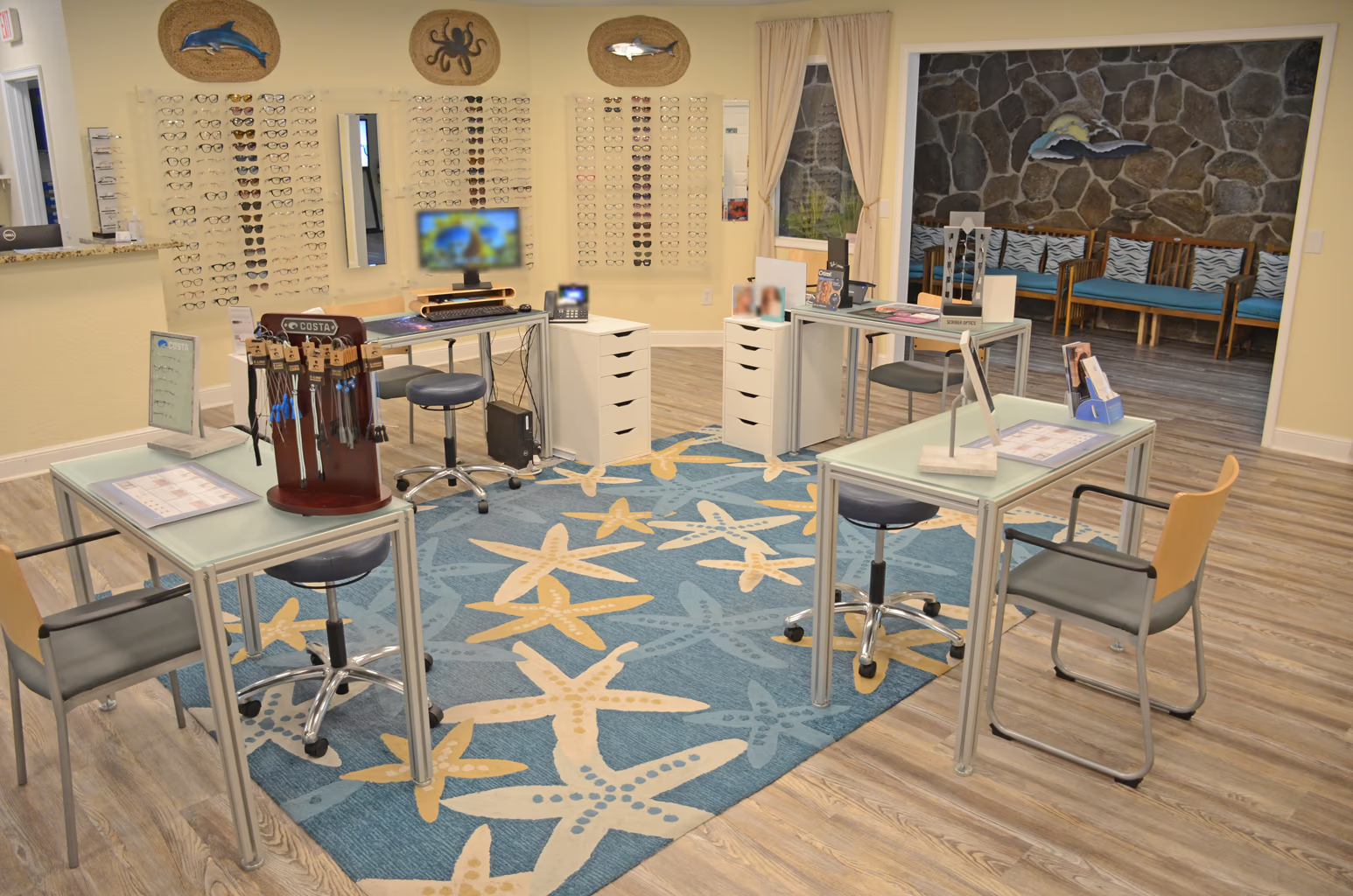
Our opticals sell about four frames for every ten comprehensive eye exams we do, so fitting lenses to frames is daily work. Downtown, you ride the elevator from the exam rooms to the full-service optical on the ground floor. At Playalinda, the optical is on the same floor as the exam rooms. Either way, you can try on frames from home first and come in with a short list.
Proper fitting takes a few minutes more for progressives than for single vision glasses, and it is worth every one of them. New glasses take about two weeks, and progressives can take a little longer.
How much do progressive lenses cost, and does insurance help?
Progressive lenses cost more than single vision lenses. The price depends on the type of progressive, the lens materials, and the lens coatings you add. Thinner, lighter materials help with stronger prescriptions. Anti-glare coating helps with night driving and screens. Photochromic lenses, the Transitions kind, darken in sunlight and clear indoors. We quote each piece before you order, so the number at the counter is the one you heard.
Many vision plans, including VSP, EyeMed, and Davis Vision, give you a frame allowance and set a price for progressives as a lens option. We read your plan before the visit and apply it at the counter. Which vision insurance our Titusville patients use walks through what those plans usually pay.
No vision plan? We take HSA and FSA cards, all major cards, and CareCredit, Cherry, or Afterpay to spread the cost out.
What if I cannot get used to my progressive lenses?
Come back and see us. We start by checking what is easy to fix: the measurements, how the frame sits on your face, and whether your prescription is right. A small frame adjustment solves more of these than you would think.
If the frame is the problem, our restyle policy covers it. You can restyle once within 90 days of pickup. Within the first 30 days you pay only the difference for a higher-priced frame. After 30 days, it is the difference plus a $75 fee. An order canceled or returned more than 48 hours after it is placed carries a 25 percent restocking fee on what you paid out of pocket.
If progressives just are not for you, that is all right too. We will talk through bifocals or two pairs of single vision glasses with you, and help you pick what fits your day.
Is the end of the year a good time to get progressive glasses in Brevard County?
For many people, yes. Many vision plans start a new plan year in January, and a new plan year usually resets the exam and the frame allowance. FSA money often runs on a calendar year too. If you have benefits left, the last weeks of the year are your chance to use them on a pair.
An exam booked now often lands sooner than one booked in mid-December. With about two weeks for glasses to arrive, an early start gives you time to settle in before the holidays.
Think about a second pair while you are here. About one frame in six that leaves our optical is a pair of sunglasses, and progressives can go into prescription sunglasses for the beach at Playalinda or the drive home on US 1. You can book your eye exam online tonight and pick a time that suits you.