
Can you wear contacts if you have astigmatism?
Yes, in most cases. Our four optometrists fit astigmatism contact lenses at both Titusville offices, Downtown at 338 S Washington Ave and Playalinda at 1114 S Washington Ave. About one exam in five that we do is a contact lens fitting, so a lens designed to correct astigmatism is ordinary work for us.
Astigmatism means the front of your eye is shaped more like a football than a basketball. Light rays focus unevenly, so you get blurry or distorted vision at every distance. Many patients notice it most at night, as halos or streaks around headlights, and some feel eye strain after a long day at screens.
Most of the time it is corneal astigmatism, from the curve of the clear front window of the eye. Lenticular astigmatism comes from the shape of the lens inside the eye. Both are a refractive error, like nearsightedness, and both show up in the refraction at your eye exam.
A standard spherical contact lens has the same power in every direction, so it cannot correct an eye that is not. That is why so many patients were told no by an eye doctor years ago. Contact lenses have changed a lot since then, and plenty of our patients who heard that answer once wear toric contacts now without a second thought.
What are toric contact lenses, and how do they stay in place?
Contact lenses made for astigmatism are called toric lenses. A toric contact lens has one power along one axis and another power along the other, to match the uneven curve of your eye. That only works if the lens sits the same way on your eye every time.
So toric contact lenses are specifically designed to settle into one position and stay there. When you blink, the lid moves across the lens, and it has to come back to where it belongs. If it turns and drifts, your vision blurs for a moment until it settles again. A good fit gives you clear, stable vision from blink to blink.
Getting that right is the whole job of a toric fitting. It is also why we never hand you a box until we have watched the lens on your own eye.
What happens at a contact lens fitting for astigmatism?
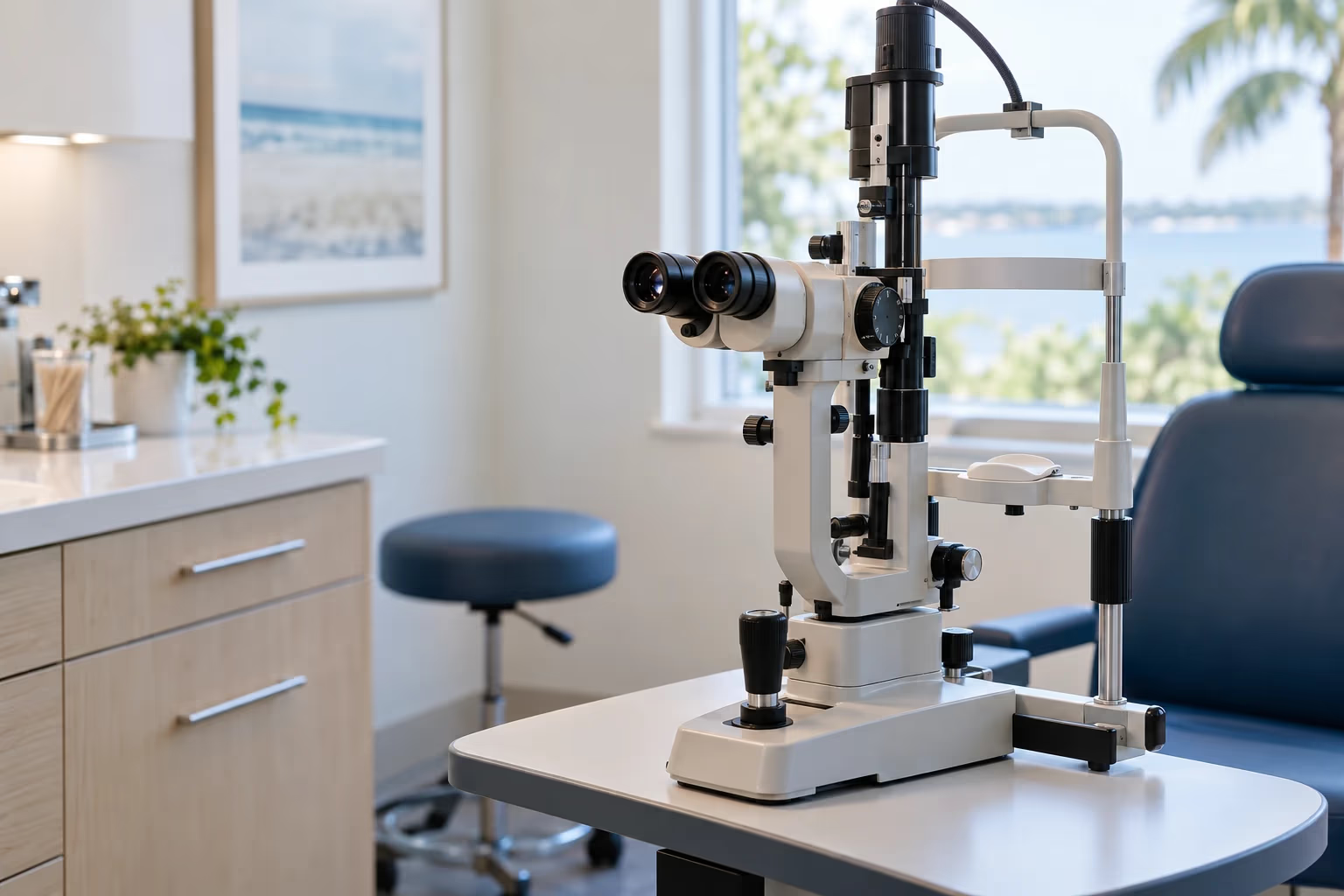
It starts with a comprehensive eye exam: your prescription, a look at the front of the eye under the slit lamp, a pressure check, and a picture of your retina. Then the fitting begins.
- 1
We measure the front of your eye
We map its curve and size, so the lens can sit where it should. These numbers are not on your glasses prescription.
- 2
We check your tear film
Dry eyes change which lens will feel comfortable by the end of the day, so we look at the surface of your eye and your tears first.
- 3
A trial lens goes on
We watch it under the microscope for centering, movement, and how well it holds its position when you blink. Then we measure your vision through the lens itself.
- 4
We try another if it is not right
Sometimes the first toric lens rotates a little or blurs. That is normal. We switch to another trial lens and look again.
- 5
You practice before you leave
If you are new to contacts, we teach you to put the lenses in and take them out, and nobody rushes that part.
A toric fitting takes a little longer than a fitting for standard contact lenses, and some patients need a short follow-up once they have worn the lenses for a while. Mention astigmatism when you book your visit so we set aside the time.
About one appointment in eight on our schedule is booked online. You can pick your time there and change it yourself later if your week shifts.
What are the best contact lenses for astigmatism?
The best lens is the one that fits your eye, your prescription, and your life. For most eyes with astigmatism that is a toric soft lens. For some, a firmer or custom lens gives clearer and steadier vision.
Your wear schedule matters too. Toric contacts come as dailies you throw away each night, and as weekly and monthly lenses that need a case and solution. We help you choose the one that suits your lifestyle and your eyes.
| Lens | Who it often suits | What to expect |
|---|---|---|
| Toric soft lens | Most eyes with astigmatism | Feels like any other contact lens. The fitting checks that it stays put when you blink. |
| Gas permeable lens (gas perm) | Astigmatism a toric lens cannot fully correct | A small, firm lens with very sharp vision. It takes a little time to get used to. |
| Custom soft lens | High astigmatism or a very strong prescription | A toric lens made to your measurements when the standard chart does not go far enough. |
| Hybrid lens (SynergEyes) | Patients who want gas perm clarity with a gentler feel | A firm center for crisp vision with a flexible outer edge for comfort. |
| Scleral lens | Keratoconus, corneal scars, eyes changed by surgery | A larger lens that vaults over the cornea on a layer of saline. Fitted over more than one visit. |
Contact lens options for astigmatism at Aker Eye
The first two rows are part of our everyday contact lens fittings. The last three are specialty contact lenses, which get their own longer visit.
What if toric lenses did not work for me before?
Then you are exactly who our specialty fittings are for. Our own appointment records from September 2025 through August 2026 say about one contact lens visit in five with us is a specialty fitting, scleral or custom. So an eye that was told no is something we work on every week.
Toric lenses keep blurring, popping out, causing discomfort, or never get you to clear for a few reasons. The astigmatism may be stronger than a toric lens can handle. The cornea may have an irregular shape, as it does with keratoconus or after an eye injury or surgery. Or the prescription may be off the end of the chart.
None of that has to close the door on contacts. A gas perm holds its own shape on the eye, so it corrects astigmatism a flexible lens cannot. A scleral lens rests on the white of the eye and gives an irregular front surface a smooth new one to see through. We measure your eye, try lenses on it, and tell you straight which one has the best chance.
Bring your glasses, any lenses you wear now, and notes from any eye surgeon or corneal specialist who has seen you. Every doctor here fits specialty lenses, at either office. Contact lenses were Dr. Greg Aker's focus back in optometry school.
Specialty fittings run busiest in December and August. If you want to start in one of those months, call a few weeks ahead and we will find you the longer visit.
How much do toric contact lenses cost, and does insurance help?
A toric fitting costs a bit more than a fitting for standard contact lenses, because it takes more measurements and sometimes another visit. Specialty lenses cost more again. The professional fees for the fitting are separate from the eye exam.
Many vision plans pay part of the fitting and give you an allowance toward the lenses you purchase. We check your benefits before you come in, so you hear the number before you sit down. Without insurance, call us at (321) 269-2021 and we will quote the exam and fitting together. Our insurance page lists the plans we work with.
How do I reorder my toric contacts once they fit?
Online, in a few minutes, whenever the box gets light. Our contact lens ordering asks whether you are a current patient, then your date of birth, phone, and email to match the prescription we have on file. There is no account to set up. You can also call us and we will place the order for you.
Your contact lens prescription is usually good for a year. When it runs out, book your yearly contact lens exam and we renew it after checking that the lens still suits your eyes. Yearly contact lens exams fill up most in January and March, so if yours is due then, book a few weeks early. Ask about the Alcon rebates when you order, since there is one for new wearers and one for current contact lens wearers through December 2026.