
What is the difference between an optometrist and an ophthalmologist?
An optometrist is a Doctor of Optometry (O.D.) who examines your eyes, writes prescriptions for glasses and contact lenses, and diagnoses and treats eye diseases. An ophthalmologist is a medical doctor who can also perform surgery on the eye. All four doctors at Aker Eye, on S Washington Ave in Titusville, are optometrists.
For most people, optometrists are the eye care providers they see year after year for primary eye care. Ophthalmologists are the surgeons you meet when an eye problem needs an operation, a laser procedure, or injections. Both are eye care professionals, trained for different work. Here is how the work splits, and where each piece happens with us.
Our own appointment records from September 2025 through August 2026 say glasses exams are about half of everything on our schedule. That everyday care is the heart of an optometrist's work, and it is where most eye problems first get noticed.
| What you need | Who does it | With us |
|---|---|---|
| A yearly eye exam and a new prescription | Optometrist | Both offices, all four doctors |
| A contact lens fitting or specialty lenses | Optometrist | Both offices |
| Glaucoma drops, dry eye care, and diabetic or macular checks | Optometrist | Both offices |
| A red, painful, or injured eye today | Optometrist first | Call (321) 269-2021 for a same-day visit |
| Cataract surgery, glaucoma laser or surgery, retina injections | Ophthalmologist | We refer you and see you before and after |
| Choosing frames and fitting the finished eyeglasses | Optician | Our optical shop at both offices |
Who does what in eye care, and where it happens with us
Is an optometrist a doctor?
Yes. Optometrists hold a Doctor of Optometry degree, which is why our doctors sign O.D. after their names. It is not a medical degree, and that is the honest line between the two: optometrists do not perform surgery, and ophthalmologists do.
Inside that line, our doctors trained hard on eye disease. Dr. Greg Aker finished the Southern College of Optometry in 1984 and is a Southern Diplomate in Glaucoma Management. Dr. Sarah Koehnemann did her residency in primary care at the SUNY College of Optometry in New York, with a special interest in low vision and ocular disease. Dr. Jennifer Bradley and Dr. Amanda Aker both did residencies at the Illinois College of Optometry in Chicago, Dr. Bradley in children's eyes and Dr. Amanda Aker in primary care and ocular disease, working beside ophthalmologists and emergency physicians. You can read each story on our doctors page.
Do ophthalmologists go to medical school?
Yes. Ophthalmologists go to medical school after a bachelor's degree and earn an M.D., or a D.O., which stands for Doctor of Osteopathic Medicine. Then they do a residency in ophthalmology, the medicine and surgery of the eye. Many ophthalmologists add a fellowship in one subspecialty, such as retina surgery, glaucoma, or the cornea.
Optometrists take a different road. After a bachelor's degree, optometry students go to optometry school instead of medical school and earn the O.D. Three of our four doctors also did a residency year after optometry school. Optometrists are licensed to examine eyes, write prescriptions, and treat many eye conditions without surgery.
What does an optometrist do at Aker Eye?
Far more than vision correction. About one visit in three with us is a medical eye visit rather than a glasses or contacts exam. That is the part of optometry most people do not expect: optometrists diagnose and treat eye diseases, and prescribe the medicine that keeps them in check.
- A comprehensive eye exam: your prescription, the pressure inside the eye, and a picture of the retina to look at your eye health
- Prescriptions for corrective lenses, from eyeglasses to contact lenses, including fittings for harder-to-fit eyes
- Glaucoma testing, diagnosis, and treatment, with pressure-lowering drops we prescribe and adjust
- Dry eye care at both offices, from a look at the oil glands in your lids to the treatment that fits the cause
- Diabetic eye exams and macular degeneration monitoring with scans of the retina
- Red eyes, eye infections, scratches on the cornea, and something stuck in the eye
- Kids' exams with Dr. Bradley and the Low Vision Clinic with Dr. Koehnemann, both at Playalinda
Many eye diseases give no warning signs until sight is already lost, and glaucoma often has no symptoms early on. Regular eye exams are preventive care: we detect a change while it is small and treat it before it costs you vision. Once a year is right for most adults, and come in sooner for any vision changes.
Medical eye visits like these usually go to your medical insurance, Medicare included, rather than your vision plan. We check your benefits before you come in.
When do you need an ophthalmologist?
You need an ophthalmologist when your eye needs surgery or a procedure we do not do in the office. Ophthalmologists work in surgical eye care, and many ophthalmologists specialize further. For our patients that usually means one of a few things. Nearly four of our exam patients in ten are 65 or over, the years when a cataract often starts to matter.
A cataract that glasses no longer help is the most common. Glaucoma that drops cannot hold may need a laser procedure or surgery. A retinal tear needs a surgeon quickly, and some retina problems need retina surgery. Wet macular degeneration is treated with injections into the eye by a retina specialist. In each case we find it, explain the diagnosis, and send you for surgical care with our scans and records ahead of you.
Testing visits are about one visit in twelve on our schedule. Those scans are how we decide, with you, whether an eye needs a surgeon or can stay in our care.
How does cataract and LASIK co-management work in Titusville?
Co-management means the surgeon does the operation and we do the visits on both sides of it, so you have one eye care team: the surgeon for the operating room, and us for the eye care before and after. You keep your own eye doctor in Titusville, and you are not driving to the surgical center for every check. Dr. Greg Aker has co-managed LASIK surgeries and the recovery of more than 4,500 surgical patients, so this is familiar ground for us.
- 1
We find it and measure it
At your exam we see the cataract, or talk through LASIK if you are considering it, and take the measurements a surgeon needs.
- 2
We send you to a surgeon we trust
Your records go ahead of you, and we tell you which questions to ask, such as which lens implant suits your eyes.
- 3
The surgeon does the operation
Cataract surgery is usually done as an outpatient, one eye at a time, a few weeks apart.
- 4
We see you while you heal
The follow-up visits assigned to us happen at the office you already use. We look at your vision, the pressure, and how the eye is healing, and go over your drops.
Once your vision settles, we measure you for whatever glasses you still need. More on the evaluation and the follow-up care is on our cataract co-management page.
Checkups after surgery are about one visit in thirty with us, steady every month of the year. Your recovery visits are routine work here, not a favor we fit in.
Optician vs optometrist: who fits your glasses?
Opticians fill the prescription. The optometrist examines your eyes and writes it, and the optician helps you choose frames and lenses, takes the measurements, and adjusts the finished pair so it sits right. Opticians do not examine eyes or make a diagnosis.
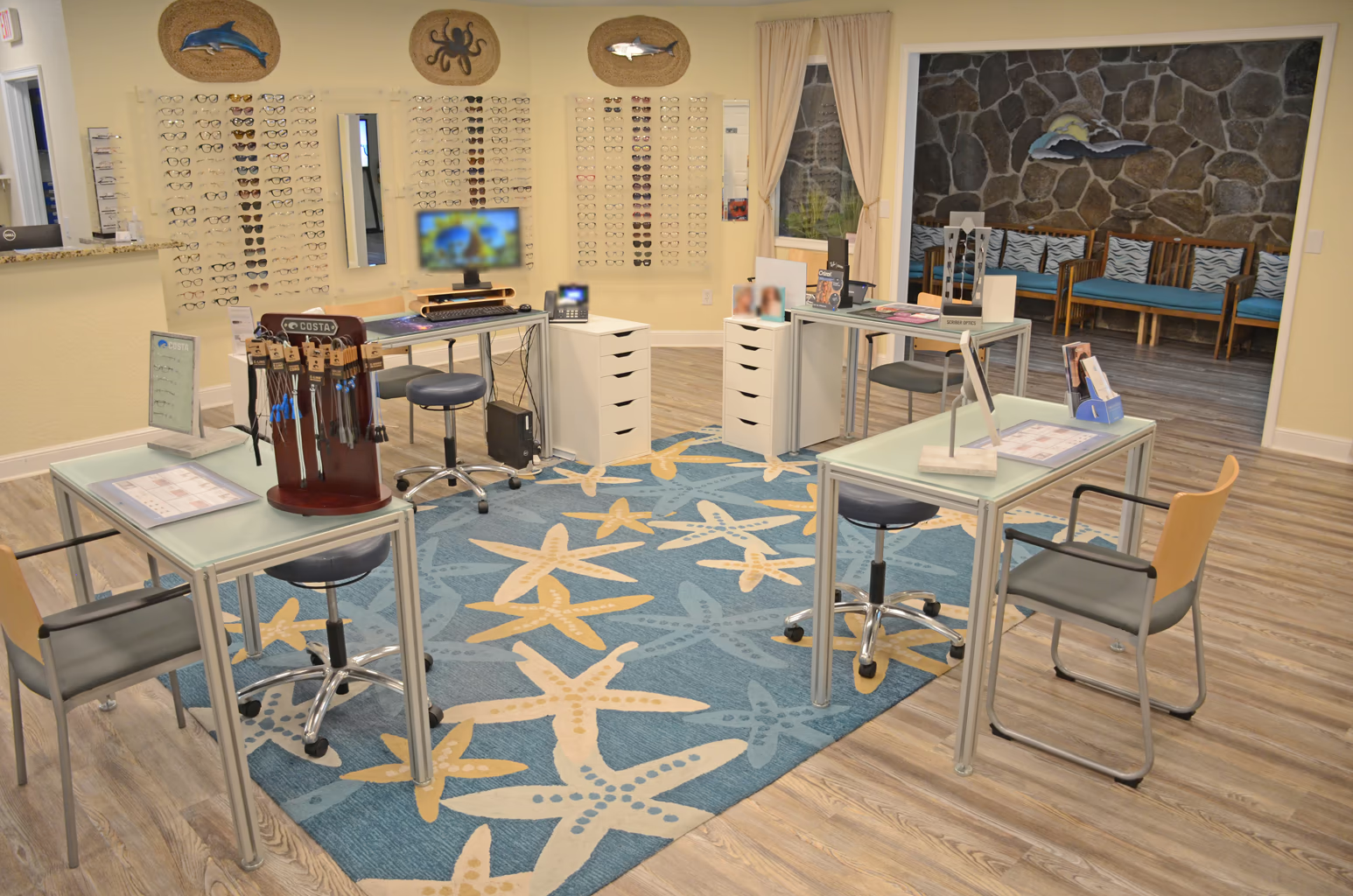
At our Downtown office the exam rooms are upstairs and the optical is on the ground floor. Playalinda has its own optical on the same floor as the exam rooms. You can also try frames on from home before you come in.
Which eye doctor should I see first in Titusville?
Start with an optometrist. Whether you need new glasses, a pressure test, or answers about a cataract, the first visit is an eye exam, and that is our work every day. If you need advanced care from a surgeon after that, we will make the referral and keep seeing you for routine eye care.
Both offices are open Monday to Friday, 8am to 5pm, and one phone number reaches both. Dr. Greg Aker and Dr. Amanda Aker see patients Downtown, and Dr. Koehnemann and Dr. Bradley at Playalinda. Same-day visits for a red, sore, or injured eye run about two a day across the practice, so call us first when something is wrong today. Book your exam online, or call us at (321) 269-2021 and we will find you a time with the right doctor.